EPUB · English
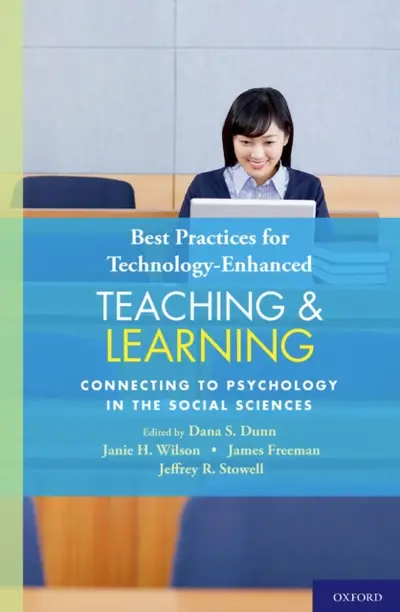
Best Practices for Technology-Enhanced Teaching and Learning
Connecting to Psychology and the Social Sciences
Price and availability
$67.99
Available in: Andorra, Austria, Australia, Belgium, Bulgaria, Canada, Switzerland, Cyprus, Czechia, Germany, Denmark, Estonia, Spain, Finland, France, United Kingdom, Guernsey, Greece, Croatia, Hungary, Ireland, Isle of Man, Iceland, Italy, Jersey, Japan, Liechtenstein, Lithuania, Luxembourg, Latvia, Monaco, Malta, Netherlands, Norway, Poland, Portugal, Romania, Sweden, Slovenia, Slovakia, San Marino, United States, Vatican City, South Africa
Stores: US, UK, Canada, EU, Australia.
Sign in to buyThe price is re-checked by the server before payment.
For personal use under the eBook licence.
- Format
- EPUB
- DRM
- Not stated by the publisher
- Language
- English
- Publisher
- Oxford University Press
- Published
- 2 February 2011
- ISBN
- 9780190453558
- Subjects
- Psychology, Child & developmental psychology, Other branches of medicine, Clinical psychology, Psychology, Child, developmental and lifespan psychology, MK, MKM
About this book
The use of technology and teaching techniques derived from technology is currently a bourgeoning topic in higher education. Teachers at all levels and types of institutions want to know how these new technologies will affect what happens in and outside of the classroom. Many teachers have already embraced some of these technologies but remain uncertain about their educational efficacy. Other teachers have waited because they are reluctant to try tools or techniques that remain unproven or, as is often the case, lack institutional support. This book is designed to help both groups, so that those with technological expertise can extend their knowledge, while technological novices can "e;ramp up"e; at their own pace and for their own purposes. Best Practices for Technology-Enhanced Teaching and Learning brings together expert teacher-scholars who apply and assess technology's impact on traditional, hybrid or blended, or completely on-line courses, relying on technology as a teaching tool for classroom management and interaction (e.g., Blackboard, PowerPoint, student response or "e;clicker systems,"e; multimedia tools), as well as student-based uses of technology largely independent of instructors (e.g., social networking on popular sites including Facebook and MySpace). Each chapter will address how technological improvements can be connected to assessment initiatives, as is now routinely advocated in psychology and social science education. The book features current scholarship and pedagogy involving innovative technology that impacts on student learning in psychology and related disciplines, focusing also on student reactions to these novel technologies, and proper assessments of how well they promote learning. This text will serve as the standard reference on emerging technologies for undergraduate instructors.
Bibliographic data © Gardners Books Ltd.