PDF · English
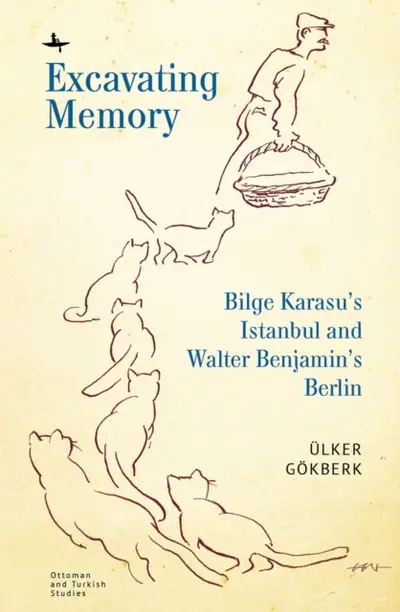
Excavating Memory
Bilge Karasu’s Istanbul and Walter Benjamin’s Berlin
Price and availability
$216.99
Available in: Andorra, Austria, Australia, Belgium, Bulgaria, Canada, Switzerland, Cyprus, Czechia, Germany, Denmark, Estonia, Spain, Finland, France, United Kingdom, Guernsey, Greece, Croatia, Hungary, Ireland, Isle of Man, Iceland, Italy, Jersey, Japan, Liechtenstein, Lithuania, Luxembourg, Latvia, Monaco, Malta, Netherlands, Norway, Poland, Portugal, Romania, Sweden, Slovenia, Slovakia, San Marino, United States, Vatican City, South Africa
Stores: US, UK, Canada, EU, Australia.
Sign in to buyThe price is re-checked by the server before payment.
For personal use under the eBook licence.
- Format
- DRM
- Not stated by the publisher
- Language
- English
- Publisher
- Academic Studies Press
- Published
- 15 September 2020
- ISBN
- 9781644694435
- Subjects
- Turkey, Middle East, Literary studies: from c 1900 -, Literary studies: fiction, novelists & prose writers, Ethnic minorities & multicultural studies, Türkiye / Turkey, Literary studies: c 1900 to c 2000, Literary studies: fiction, novelists and prose writers, Comparative literature, Ethnic groups and multicultural studies
About this book
This study moves the acclaimed Turkish fiction writer Bilge Karasu (1930-1995) into a new critical arena by examining his poetics of memory, as laid out in his narratives on Istanbul's Beyoglu, once a cosmopolitan neighborhood called Pera. Karasu established his fame in literary criticism as an experimental modernist, but while themes such as sexuality, gender, and oppression have received critical attention, an essential tenet of Karasu's oeuvre, the evocation of ethno-cultural identity, has remained unexplored: Excavating Memory brings to light this dimension. Through his non-referential and ambiguous renderings of memory, Karasu gives in his Beyoglu narratives unique expression to ethno-cultural difference in Turkish literature, and lets through his own repressed minority identity. By using Walter Benjamin's autobiographical work as a heuristic premise for illuminating Karasu, Gokberk establishes an innovative intercultural framework, which brings into dialogue two representative writers of the twentieth century over temporal and spatial distances.
Bibliographic data © Gardners Books Ltd.