PDF · English
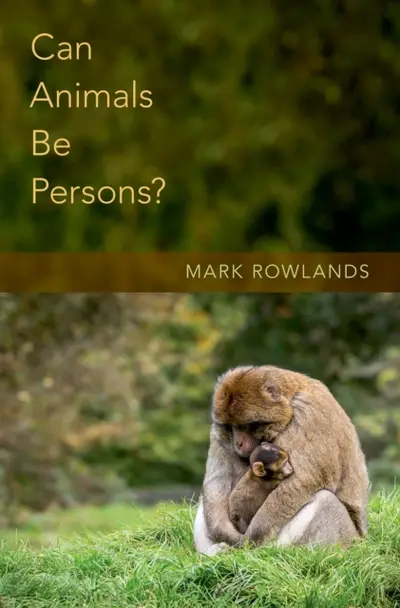
Can Animals Be Persons?
Price and availability
$28.99
Available in: Andorra, Austria, Australia, Belgium, Bulgaria, Canada, Switzerland, Cyprus, Czechia, Germany, Denmark, Estonia, Spain, Finland, France, United Kingdom, Guernsey, Greece, Croatia, Hungary, Ireland, Isle of Man, Iceland, Italy, Jersey, Japan, Liechtenstein, Lithuania, Luxembourg, Latvia, Monaco, Malta, Netherlands, Norway, Poland, Portugal, Romania, Sweden, Slovenia, Slovakia, San Marino, United States, Vatican City, South Africa
Stores: US, UK, Canada, EU, Australia.
Sign in to buyThe price is re-checked by the server before payment.
For personal use under the eBook licence.
- Format
- DRM
- Not stated by the publisher
- Language
- English
- Publisher
- Oxford University Press
- Published
- 23 April 2019
- ISBN
- 9780190846046
- Subjects
- Ethics & moral philosophy, Cosmology & the universe, Cosmology and the universe, QDTQ
About this book
Can animals be persons? To this question, scientific and philosophical consensus has taken the form of a resounding, 'No!' In this book, Mark Rowlands disagrees. Not only can animals be persons, many of them probably are. Taking, as his starting point, John Locke's classic definition of a person, as "e;a thinking intelligent being, that has reason and reflection, and can consider itself the same thinking thing, in different times and places,"e; Rowlands argues that many animals can satisfy all of these conditions. A person is an individual in which four features coalesce: consciousness, rationality, self-awareness and other-awareness, and many animals are such individuals. Consciousness--something that is like to have an experience--is widely distributed through the animal kingdom. Many animals are capable of both causal and logical reasoning. Many animals are also self-aware, since a form of self-awareness is essentially built into the possession of conscious experience. And some animals are capable of a kind of awareness of the minds of others, quite independently of whether they possess a theory of mind. This is not just a book about animals, however. As well as being fascinating in their own right, animals, as Claude Levi-Strauss once put it, are "e;good to think."e; In this seamless interweaving of the empirical study of animal minds with philosophy and its history, this book makes a powerful case for the idea that reflection on animals allows us to better understand each of these four pillars of personhood, and so illuminates what means for any individual--animal or human--to be conscious, rational, self- and other-aware.
Bibliographic data © Gardners Books Ltd.