PDF · English
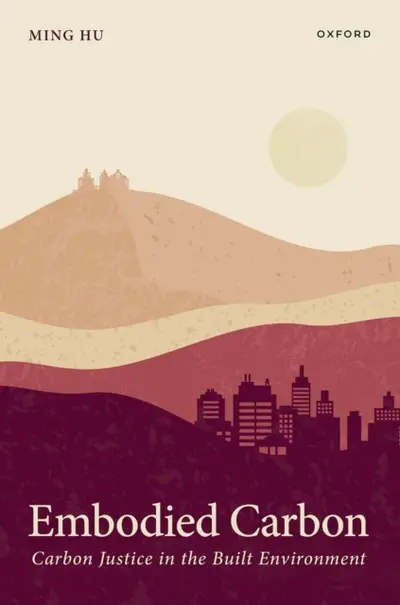
Embodied Carbon
Carbon Justice in the Built Environment
Price and availability
$124.99
Available in: Andorra, Austria, Australia, Belgium, Bulgaria, Canada, Switzerland, Cyprus, Czechia, Germany, Denmark, Estonia, Spain, Finland, France, United Kingdom, Guernsey, Greece, Croatia, Hungary, Ireland, Isle of Man, Iceland, Italy, Jersey, Japan, Liechtenstein, Lithuania, Luxembourg, Latvia, Monaco, Malta, Netherlands, Norway, Poland, Portugal, Romania, Sweden, Slovenia, Slovakia, San Marino, United States, Vatican City, South Africa
Stores: US, UK, Canada, EU, Australia.
Sign in to buyThe price is re-checked by the server before payment.
For personal use under the eBook licence.
- Format
- DRM
- Not stated by the publisher
- Language
- English
- Publisher
- Oxford University Press
- Published
- 23 July 2025
- ISBN
- 9780198944461
- Subjects
- Sustainability, Urban & municipal planning, Environmental science, engineering & technology, Sustainability, Urban and municipal planning and policy, Environmental science, engineering and technology
About this book
The global implications surrounding embodied carbon- the total greenhouse gas emissions associated with the production, transportation, assembly, and deconstruction of building materials-are often overlooked. Embodied Carbon challenges the conventional focus on operational carbon, focusing on the inequalities between the Global North and South. Part I traces the historical evolution of embodied carbon, clarifying its definitions, components, measurement and counting methods, and the critical connection between embodied carbon and climate change. Part II delves into the complexities and hidden biases that distort our understanding and approaches to sustainability, particularly the global North bias and the overreliance on high-tech solutions. It highlights how these biases perpetuate environmental disparities and marginalise low-tech, accessible solutions that could benefit broader segments of society. In Part III, we shift to current global efforts and potential pathways forward. Hu offers a comprehensive analysis of existing regulations and policies related to embodied carbon and proposes a low-tech, low-process approach that draws from traditional and indigenous knowledge. The final chapter synthesizes multidisciplinary expert perspectives, offering a new framework for creating equitable and effective solutions to reduce embodied carbon emissions.
Bibliographic data © Gardners Books Ltd.