EPUB · English
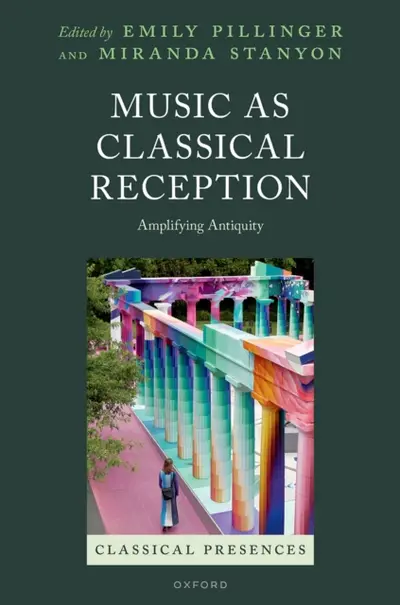
Music as Classical Reception
Amplifying Antiquity
Price and availability
$93.99
Available in: Andorra, Austria, Australia, Belgium, Bulgaria, Canada, Switzerland, Cyprus, Czechia, Germany, Denmark, Estonia, Spain, Finland, France, United Kingdom, Guernsey, Greece, Croatia, Hungary, Ireland, Isle of Man, Iceland, Italy, Jersey, Japan, Liechtenstein, Lithuania, Luxembourg, Latvia, Monaco, Malta, Netherlands, Norway, Poland, Portugal, Romania, Sweden, Slovenia, Slovakia, San Marino, United States, Vatican City, South Africa
Stores: US, UK, Canada, EU, Australia.
Sign in to buyThe price is re-checked by the server before payment.
For personal use under the eBook licence.
- Format
- EPUB
- DRM
- Not stated by the publisher
- Language
- English
- Publisher
- Oxford University Press
- Published
- 20 November 2025
- ISBN
- 9780198958000
- Subjects
- Theory of music & musicology, Music recording & reproduction, Literary studies: classical, early & medieval, Theory of music and musicology, Music recording and reproduction, Literary studies: ancient, classical and medieval
About this book
Musical as Classical Reception: Amplifying Antiquity investigates music as a site of classical reception from the early modern rise of opera to contemporary hip-hop. The volume's contributors explore topics across musical genres and classical sources--myth, epic, lyric, history, philosophy, archaeology--to demonstrate the enduring importance of music to engagements with classical antiquity, and vice versa. The wealth of music inspired by ancient Greece and Rome rests on an apparent paradox: compared with visual art, linguistic texts, or even material culture and architecture, precious little remains of ancient music, and what traces have remained are not audible in any straightforward sense; nonetheless, classical antiquity has provoked and permitted an extraordinary variety and volume of musical receptions. This edited collection offers case studies of the generative encounter between antiquity and later music makers, but also asks how new sounds are imagined as emerging from near-silence. Can a reception not only echo the past, but make the past louder, turning up the volume on what is currently muted or inaudible? In short, what does it mean to amplify antiquity? The volume proposes amplification as a new model for reception studies with relevance to the wider field, as a set of technologies, a rhetorical technique, and a sonic concept. Drawing on classics, music, sound studies, literary studies, and intellectual and cultural history, the chapters explore three different modes and contexts of reception: musical settings of ancient words; musical reimaginings of ancient lives, ideas, and myths; and the expansive and sometimes oblique encounters with Graeco-Roman antiquity that are powered by electric amplification and the media changes that come in its wake.
Bibliographic data © Gardners Books Ltd.