PDF · English
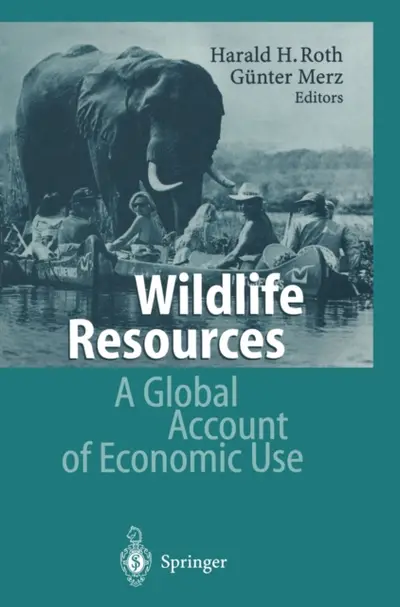
Wildlife Resources
A Global Account of Economic Use
Price and availability
$134.99
Available in: Andorra, Austria, Australia, Belgium, Bulgaria, Canada, Switzerland, Cyprus, Czechia, Germany, Denmark, Estonia, Spain, Finland, France, United Kingdom, Guernsey, Greece, Croatia, Hungary, Ireland, Isle of Man, Iceland, Italy, Jersey, Japan, Liechtenstein, Lithuania, Luxembourg, Latvia, Monaco, Malta, Netherlands, Norway, Poland, Portugal, Romania, Sweden, Slovenia, Slovakia, San Marino, United States, Vatican City, South Africa
Stores: US, UK, Canada, EU, Australia.
Sign in to buyThe price is re-checked by the server before payment.
For personal use under the eBook licence.
- Format
- DRM
- Not stated by the publisher
- Language
- English
- Publisher
- Springer Berlin Heidelberg
- Published
- 29 June 2013
- ISBN
- 9783662033845
- Subjects
- Ecological science, the Biosphere, Zoology & animal sciences, Animal ecology, Earth sciences, Conservation of the environment, Ecological science, the Biosphere, Zoology and animal sciences, Earth sciences, Conservation of the environment
About this book
The general interest and attention paid to the use of the renewable natural resources of the world have increased greatly during the last decades. This is due to the environmental dilemma into which mankind has got itself by the total disregard of ecological facts and laws, the underprizing of natural resources and the overemphasis on economic develop- ment, coupled with unimpeded rapid population growth and the preponderance of material- istic consumption-oriented attitudes. The management and use of natural resources such as forests, grasslands, rivers and lakes were formerly considered purely in a financial context, whereas latterly, a consciousness of their social function and the indirect economic benefits which can be derived from them has developed. Thus, as regards these traditional resources, multi-use concepts comprising eco- nomically oriented utilisation as well as recreational, educational and social use have be- come widely accepted. Conservation of natural resources for sustainable consumptive as well as non-consumptive uses has been recognised as a key element for maintaining eco- nomic development all over the world. Fortunately, the industrialised countries have started to apply this principle themselves and in their technical and financial aid to the developing Third World countries. This is manifest from policy documents such as the World Bank Policy on Development of Wild Lands, issued in 1987.
Bibliographic data © Gardners Books Ltd.