EPUB · English
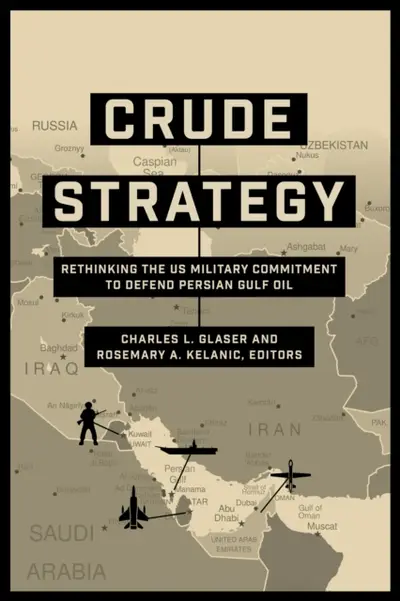
Crude Strategy
Rethinking the US Military Commitment to Defend Persian Gulf Oil
Price and availability
$39.99
Available in: Andorra, Austria, Australia, Belgium, Bulgaria, Canada, Switzerland, Cyprus, Czechia, Germany, Denmark, Estonia, Spain, Finland, France, United Kingdom, Guernsey, Greece, Croatia, Hungary, Ireland, Isle of Man, Iceland, Italy, Jersey, Japan, Liechtenstein, Lithuania, Luxembourg, Latvia, Monaco, Malta, Netherlands, Norway, Poland, Portugal, Romania, Sweden, Slovenia, Slovakia, San Marino, United States, Vatican City, South Africa
Stores: US, UK, Canada, EU, Australia.
Sign in to buyThe price is re-checked by the server before payment.
For personal use under the eBook licence.
- Format
- EPUB
- DRM
- Not stated by the publisher
- Language
- English
- Publisher
- Georgetown University Press
- Published
- 12 August 2016
- ISBN
- 9781626163362
- Subjects
- Arabian peninsula, USA, International relations, Theory of warfare & military science, Defence strategy, planning & research, Petroleum & oil industries, Politics and government, Central / national / federal government policies, Warfare and defence
About this book
<p>Should the United States ask its military to guarantee the flow of oil from the Persian Gulf? If the US security commitment is in fact strategically sound, what posture should the military adopt to protect Persian Gulf oil?</p><p>Charles L. Glaser and Rosemary A. Kelanic present a collection of new essays from a multidisciplinary team of political scientists, historians, and economists that provide answers to these questions. Contributors delve into a range of vital economic and security issues: the economic costs of a petroleum supply disruption, whether or not an American withdrawal increases the chances of oil-related turmoil, the internal stability of Saudi Arabia, budgetary costs of the forward deployment of US forces, and the possibility of blunting the effects of disruptions with investment in alternative energy resources. The result is a series of bold arguments toward a much-needed revision of US policy toward the Persian Gulf during an era of profound change in oil markets and the balance of power in the Middle East. </p>
Bibliographic data © Gardners Books Ltd.