EPUB · English
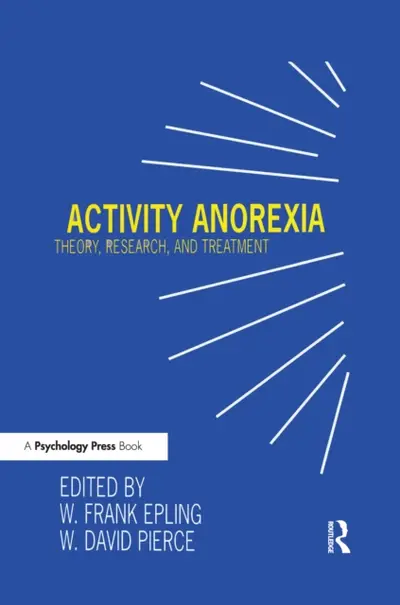
Activity Anorexia
Theory, Research, and Treatment
Price and availability
$74.99
Available in: Andorra, Austria, Australia, Belgium, Bulgaria, Canada, Switzerland, Cyprus, Czechia, Germany, Denmark, Estonia, Spain, Finland, France, United Kingdom, Guernsey, Greece, Croatia, Hungary, Ireland, Isle of Man, Iceland, Italy, Jersey, Japan, Liechtenstein, Lithuania, Luxembourg, Latvia, Monaco, Malta, Netherlands, Norway, Poland, Portugal, Romania, Sweden, Slovenia, Slovakia, San Marino, United States, Vatican City, South Africa
Stores: US, UK, Canada, EU, Australia.
Sign in to buyThe price is re-checked by the server before payment.
For personal use under the eBook licence.
- Format
- EPUB
- DRM
- Not stated by the publisher
- Language
- English
- Publisher
- Taylor & Francis
- Published
- 17 June 2013
- ISBN
- 9781134794577
- Subjects
- Psychology, Physiological & neuro-psychology, biopsychology, Health psychology, Clinical psychology, Eating disorders & therapy, Psychiatric and mental disorders, Neurosciences
About this book
This volume provides researchers and clinicians with an insight into recent developments in activity anorexia. Much of the basic information on the topic has come from animal literature; the theory of activity anorexia is built on an animal model of self-starvation (rats placed on a single daily feeding run more and more, over days stop eating, and die of starvation). Additionally, experiments that for ethical or practical reasons could not be done with humans may be conducted with other animals. The animal research is extending the understanding of biologically-based reward mechanisms that regulate eating and exercise, environment-behavior interactions that affect anorexia, and the biochemical changes that accompany physical activity and starvation. Increasingly, however, the impact of physical activity on human anorexia is being directly investigated--eight out of fourteen research chapters in this volume are based on human research. Some researchers are interested in the impact of hyperactivity and caloric restriction on human reproductive function. Other authors are investigating physically active subgroups of people considered to be at risk for anorexia. Finally, several clinician/researchers suggest how physical activity and extreme dieting interact for anorexia nervosa patients. Chapter authors were asked to present their views independent of the editors' argument that, when it is present, physical activity is central to anorexia. Many of the contributors disagree with the editors about the details of activity anorexia. A few suggest that excessive physical activity is either incidental to, or an epiphenomenon of, anorexia. Most authors are, however, in accord with the view that physical activity reduces food consumption which further drives up activity that results in even less caloric intake. No matter what their perspective, all contributors agree that hyperactivity frequently accompanies self-starvation in humans and other animals. The end result is a lively book that provides a source of ideas for both researchers and practitioners.
Bibliographic data © Gardners Books Ltd.