PDF · English
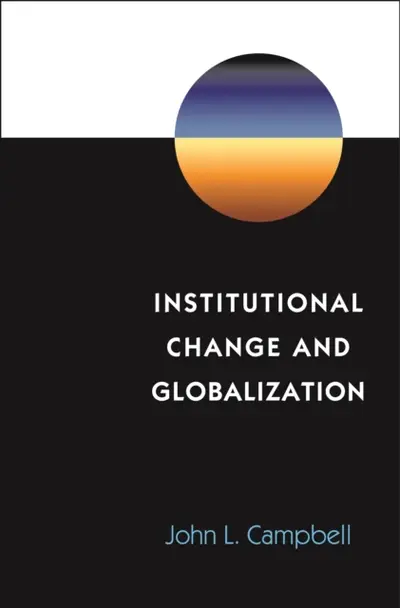
Institutional Change and Globalization
Price and availability
$54.99
Available in: Andorra, Austria, Australia, Belgium, Bulgaria, Canada, Switzerland, Cyprus, Czechia, Germany, Denmark, Estonia, Spain, Finland, France, United Kingdom, Guernsey, Greece, Croatia, Hungary, Ireland, Isle of Man, Iceland, Italy, Jersey, Japan, Liechtenstein, Lithuania, Luxembourg, Latvia, Monaco, Malta, Netherlands, Norway, Poland, Portugal, Romania, Sweden, Slovenia, Slovakia, San Marino, United States, Vatican City, South Africa
Stores: US, UK, Canada, EU, Australia.
Sign in to buyThe price is re-checked by the server before payment.
For personal use under the eBook licence.
- Format
- DRM
- Not stated by the publisher
- Language
- English
- Publisher
- Princeton University Press
- Published
- 21 July 2020
- ISBN
- 9780691216348
- Subjects
- Globalization, Sociology & anthropology, Sociology, Economic theory & philosophy, Economic theory and philosophy
About this book
This book is about institutional change, how to recognize it, when it occurs, and the mechanisms that cause it to happen. It is the first book to identify problems with the "e;new institutional analysis,"e; which has emerged as one of the dominant approaches to the study of organizations, economic and political sociology, comparative political economy, politics, and international relations. The book confronts several important problems in institutional analysis, and offers conceptual, methodological, and theoretical tools for resolving them. It argues that the paradigms of institutional analysis--rational choice, organizational, and historical institutionalism--share a set of common analytic problems. Chief among them: failure to define clearly what institutional change is; failure to specify the mechanisms responsible for institutional change; and failure to explain adequately how "e;ideas"e; other than self-interests affect institutional change. To demonstrate the utility of his tools for resolving the problems of institutional analysis, Campbell applies them to the phenomenon of globalization. In doing so, he not only corrects serious misunderstandings about globalization, but also develops a new theory of institutional change. This book advances the new institutional analysis by showing how the different paradigms can benefit from constructive dialogue and cross-fertilization.
Bibliographic data © Gardners Books Ltd.