PDF · English
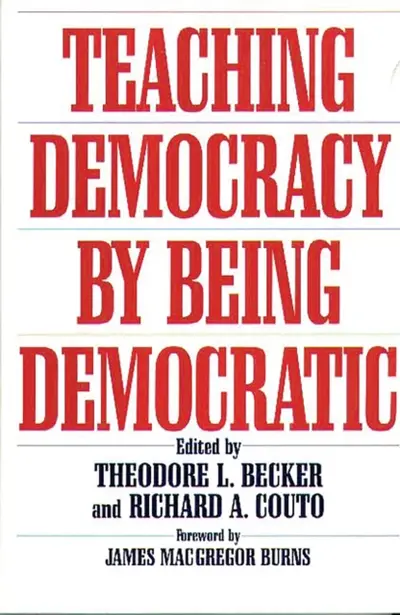
Teaching Democracy by Being Democratic
Price and availability
$43.99
Available in: Andorra, Austria, Australia, Belgium, Bulgaria, Canada, Switzerland, Cyprus, Czechia, Germany, Denmark, Estonia, Spain, Finland, France, United Kingdom, Guernsey, Greece, Croatia, Hungary, Ireland, Isle of Man, Iceland, Italy, Jersey, Japan, Liechtenstein, Lithuania, Luxembourg, Latvia, Monaco, Malta, Netherlands, Norway, Poland, Portugal, Romania, Sweden, Slovenia, Slovakia, San Marino, United States, Vatican City, South Africa
Stores: US, UK, Canada, EU, Australia.
Sign in to buyThe price is re-checked by the server before payment.
For personal use under the eBook licence.
- Format
- DRM
- Not stated by the publisher
- Language
- English
- Publisher
- Bloomsbury Publishing (USA)
- Published
- 30 October 1996
- Pages
- 200
- ISBN
- 9780313390975
- Subjects
- Philosophy & theory of education, Teaching of a specific subject, Politics & government, Political structures: democracy, Philosophy and theory of education, Teaching of a specific subject, Politics and government, Political structures / systems: democracy
About this book
The best way to teach democracy has been the subject of an ongoing debate for 2,500 years. Unlike most books about teaching democracy, this one spends more time on how to teach democracy than the what and why of teaching democracy. It punctures the irony of teaching democracy by lectures and superior teachers. In its place, this book provides a variety of illustrations for the teaching of democracy in an experiential and egalitarian fashion. The introduction presents a theoretical and analytical framework of democracy and democratic pedagogy. The six chapters cover topics such as structuring a democratic classroom; democratic practices that empower students; problem solving and community service that make the classroom a laboratory for democracy; and university-based programs of democratic alternatives that serve the community. The volume's treatment of community organization, students as collaborators, personal empowerment, the community of need and response, and the democratic organization expresses its preference for direct democratic participation.
Bibliographic data © Gardners Books Ltd.