PDF · English
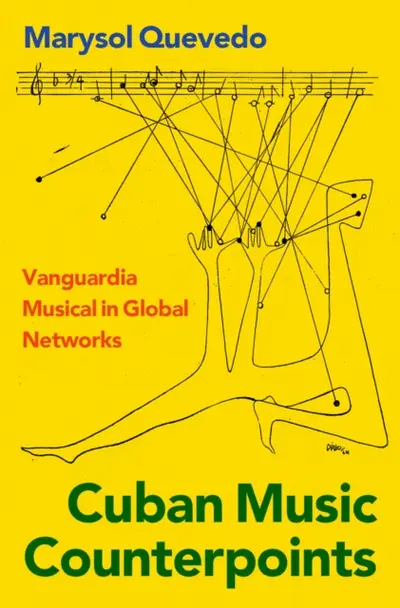
Cuban Music Counterpoints
Vanguardia Musical in Global Networks
Price and availability
$74.99
Available in: Andorra, Austria, Australia, Belgium, Bulgaria, Canada, Switzerland, Cyprus, Czechia, Germany, Denmark, Estonia, Spain, Finland, France, United Kingdom, Guernsey, Greece, Croatia, Hungary, Ireland, Isle of Man, Iceland, Italy, Jersey, Japan, Liechtenstein, Lithuania, Luxembourg, Latvia, Monaco, Malta, Netherlands, Norway, Poland, Portugal, Romania, Sweden, Slovenia, Slovakia, San Marino, United States, Vatican City, South Africa
Stores: US, UK, Canada, EU, Australia.
Sign in to buyThe price is re-checked by the server before payment.
For personal use under the eBook licence.
- Format
- DRM
- Not stated by the publisher
- Language
- English
- Publisher
- Oxford University Press
- Published
- 8 August 2023
- ISBN
- 9780197552247
- Subjects
- Cuba, c 1939 to c 1945 (including WW2), c 1945 to c 2000 (Post-war period), Music, Music reviews & criticism, 20th century & contemporary classical music, World music, Cuba, 3MPBLB, 3MPQ, Music, Music reviews and criticism, AVLA, AVLW
About this book
Cuban Music Counterpoints maps the intellectual and artistic networks Cuban composers forged between 1940 and 1991 by exploring moments--concerts, festivals, recordings--that shed light on how they negotiated aesthetic and political agendas at local and international levels. Beginning with the modernist neoclassicism of the Grupo de Renovacion Musical in the 1940s and its Pan Americanist backdrop, the book moves through the more turbulent 1950s, when a more politically engaged organization, the Sociedad Cultural Nuestro Tiempo, promoted contemporary socially engaged art of Cuba and the Americas. Their activities set the stage for the post-1959 Revolutionary period of aesthetic and political experimentation in the 1960s, subsequent institutionalization of the 1970s, and the pluralist global turn of the 1980s. Through musical analysis, reception history, and historical contextualization, various case studies demonstrate that, due to music's polyvalent capacities, composers were able to experiment aesthetically with a much higher degree of freedom than their Cuban counterparts in other artistic fields--such as literature and visual arts--as well as their counterparts in other socialist countries, such as East Germany and the Soviet Union. Three key terms--innovation, revolution, and vanguardia--serve as anchors for exploring how composers tied the post-revolutionary present and future to the pre-revolutionary past. The aesthetic and political concepts of cubania (Cubanness), national identity versus cosmopolitanism and universalism, modernism, Pan-Americanism, internationalism, socialism, and the revolution, guide our understandings of how Cuban composers created meaning and connected their work to vast local and global networks of art music production. This book sheds light not only on the classical music scene in Cuba, but also the international classical music network with which Cuban composers engaged during this time.
Bibliographic data © Gardners Books Ltd.