EPUB · English
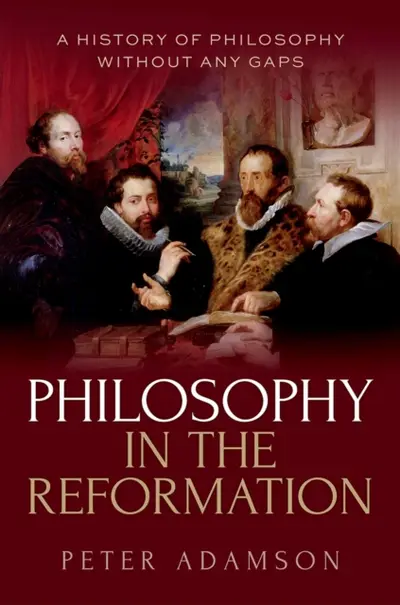
Philosophy in the Reformation
A history of philosophy without any gaps, Volume 8
Price and availability
$21.99
Available in: Andorra, Austria, Australia, Belgium, Bulgaria, Canada, Switzerland, Cyprus, Czechia, Germany, Denmark, Estonia, Spain, Finland, France, United Kingdom, Guernsey, Greece, Croatia, Hungary, Ireland, Isle of Man, Iceland, Italy, Jersey, Japan, Liechtenstein, Lithuania, Luxembourg, Latvia, Monaco, Malta, Netherlands, Norway, Poland, Portugal, Romania, Sweden, Slovenia, Slovakia, San Marino, United States, Vatican City, South Africa
Stores: US, UK, Canada, EU, Australia.
Sign in to buyThe price is re-checked by the server before payment.
For personal use under the eBook licence.
- Format
- EPUB
- DRM
- Not stated by the publisher
- Language
- English
- Publisher
- Oxford University Press
- Published
- 24 March 2026
- ISBN
- 9780198991199
- Subjects
- Europe, c 1000 CE to c 1500, c 1500 to c 1600, European history, Early history: c 500 to c 1450/1500, Early modern history: c 1450/1500 to c 1700, Western philosophy: Medieval & Renaissance, c 500 to c 1600, Philosophy: metaphysics & ontology, Philosophy: epistemology & theory of knowledge, Ethics & moral philosophy, Social & political philosophy, Philosophy of religion, Medieval Western philosophy, Philosophy: metaphysics and ontology, Philosophy: epistemology and theory of knowledge, Ethics and moral philosophy, Social and political philosophy, Philosophy of religion
About this book
In this latest volume of A History of Philosophy Without Any Gaps, Peter Adamson presents a lively and accessible introduction to European philosophy during the fifteenth and sixteenth centuries. Philosophy in the Reformation focuses on the parallel and intertwining emergence of humanism and of religious reform, as figures like Erasmus, Luther, and Calvin remade the intellectual and spiritual life of Europe. In the first three parts of the book, philosophical developments in central Europe, France, and Britain are examined. A wide range of topics and controversies are discussed, from debates over free will to the legitimacy of tyrannicide. This was also the time of the Northern Renaissance, which saw a resurgence of ancient concepts like skepticism and atomist theories of matter. The volume's final section charts the Catholic reaction to these epochal events in the Counter-Reformation, and especially the ideas of Spanish thinkers like Molina and Surez. Quite a few familiar figures are discussed, such as Montaigne and Copernicus. But as always in this series, Adamson lavishes attention on fascinating figures who are often ignored in the history of philosophy, like John Dee, Robert Fludd, and Oliva Sabuco (who is just one of numerous women intellectuals covered). Another feature of the book is its attention to literature and the arts: the reader will learn how the achievements of Drer, Michelangelo, Shakespeare, and Cervantes relate to philosophical currents of the time. The eighth volume in the A History of Philosophy Without Any Gaps series takes us to the threshold of the early modern era and sets the stage for the developments that unfolded during the Enlightenment.
Bibliographic data © Gardners Books Ltd.