EPUB · English
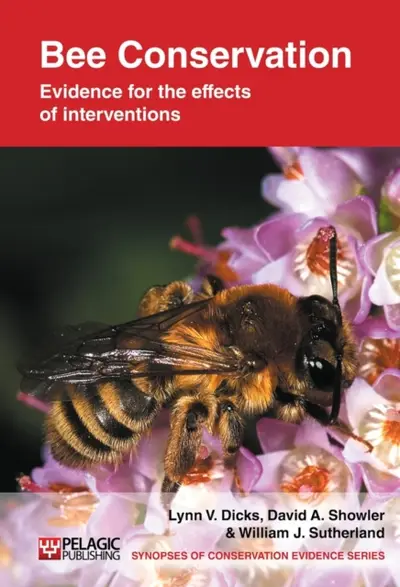
Bee Conservation
Evidence for the effects of interventions
Price and availability
$27.99
Available in: Andorra, Austria, Australia, Belgium, Bulgaria, Canada, Switzerland, Cyprus, Czechia, Germany, Denmark, Estonia, Spain, Finland, France, United Kingdom, Guernsey, Greece, Croatia, Hungary, Ireland, Isle of Man, Iceland, Italy, Jersey, Japan, Liechtenstein, Lithuania, Luxembourg, Latvia, Monaco, Malta, Netherlands, Norway, Poland, Portugal, Romania, Sweden, Slovenia, Slovakia, San Marino, United States, Vatican City, South Africa
Stores: US, UK, Canada, EU, Australia.
Sign in to buyThe price is re-checked by the server before payment.
For personal use under the eBook licence.
- Format
- EPUB
- DRM
- Not stated by the publisher
- Language
- English
- Publisher
- Pelagic Publishing
- Published
- 1 January 2010
- ISBN
- 9781907807022
- Subjects
- Animal ecology, Insects (entomology), Conservation of wildlife & habitats, Wildlife: butterflies, other insects & spiders, Ecological science, the Biosphere, Zoology and animal sciences, Zoology: invertebrates, Conservation of wildlife and habitats, Wildlife: butterflies, other insects and spiders: general interest
About this book
This book brings together scientific evidence and experience relevant to the practical conservation of wild bees. The authors worked with an international group of bee experts and conservationists to develop a global list of interventions that could benefit wild bees. They range from protecting natural habitat to controlling disease in commercial bumblebee colonies.For each intervention, the book summarises studies captured by the Conservation Evidence project, where that intervention has been tested and its effects on bees quantified. The result is a thorough guide to what is known, or not known, about the effectiveness of bee conservation actions throughout the world. Bee Conservation is the first in a series of synopses that will cover different species groups and habitats, gradually building into a comprehensive summary of evidence on the effects of conservation interventions for all biodiversity throughout the world.By making evidence accessible in this way, we hope to enable a change in the practice of conservation, so it can become more evidence-based. We also aim to highlight where there are gaps in knowledge.Evidence from all around the world is included. If there appears to be a bias towards evidence from northern European or North American temperate environments, this reflects a current bias in the published research that is available to us. Conservation interventions are grouped primarily according to the relevant direct threats, as defined in the International Union for the Conservation of Nature (IUCN) s Unified Classification of Direct Threats.
Bibliographic data © Gardners Books Ltd.