PDF · English
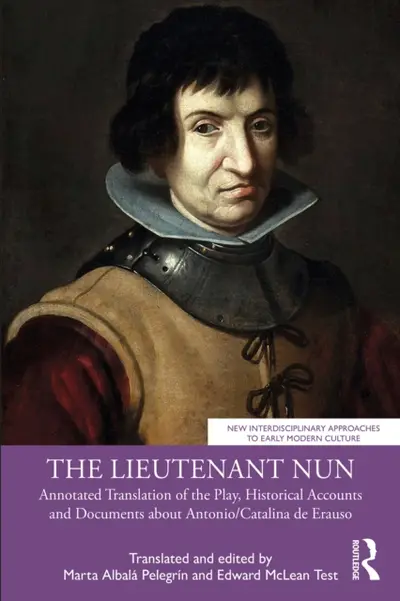
Lieutenant Nun
Annotated Translation of the Play, Historical Accounts and Documents about Antonio/Catalina de Erauso
Price and availability
$52.99
Available in: Andorra, Austria, Australia, Belgium, Bulgaria, Canada, Switzerland, Cyprus, Czechia, Germany, Denmark, Estonia, Spain, Finland, France, United Kingdom, Guernsey, Greece, Croatia, Hungary, Ireland, Isle of Man, Iceland, Italy, Jersey, Japan, Liechtenstein, Lithuania, Luxembourg, Latvia, Monaco, Malta, Netherlands, Norway, Poland, Portugal, Romania, Sweden, Slovenia, Slovakia, San Marino, United States, Vatican City, South Africa
Stores: US, UK, Canada, EU, Australia.
Sign in to buyThe price is re-checked by the server before payment.
For personal use under the eBook licence.
- Format
- DRM
- Not stated by the publisher
- Language
- English
- Publisher
- Taylor & Francis
- Published
- 19 May 2025
- ISBN
- 9781040326701
- Subjects
- Latin America, Performance art, Theatre studies, Translation & interpretation, General & world history, European history, History of the Americas, Social & cultural history, Colonialism & imperialism, Gender studies: women, Spain, Plays, playscripts, drama, LGBTQIA+ Studies / topics, History of the Americas
About this book
This volume contains the English translation of the seventeenth-century literary and archival materials about a Basque person who died under the name Antonio de Erauso (b. ~1580, d. 1650), bringing readers closer to an individual who could be considered a trans ancestor.Born into a noble family in San Sebastian, Spain, as Catalina de Erauso, Erauso lived most of their life as a man, serving as a soldier in Peru and Chile, and working as a muleteer in Mexico until their death in 1650. This book provides - for the first time - an English translation of texts related to Erauso: the contemporary play Famosa comedia de la monja alferez (The Famous Play of the Lieutenant Nun), contemporary Accounts (Relaciones) about Erauso, selected archival documents about Erauso's Petition for a Pension to the Council of the Indies, and contemporary letters mentioning Erauso.This book presents early modern scholars working in English with new material essential to understanding the historical and literary figure of Erauso, and historical documentation that provides a glimpse into the terms Erauso (and others) seemingly chose for themselves.
Bibliographic data © Gardners Books Ltd.