PDF · English
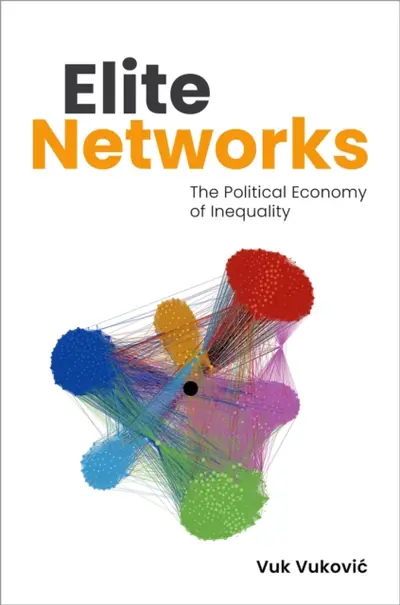
Elite Networks
The Political Economy of Inequality
Price and availability
$25.99
Available in: Andorra, Austria, Australia, Belgium, Bulgaria, Canada, Switzerland, Cyprus, Czechia, Germany, Denmark, Estonia, Spain, Finland, France, United Kingdom, Guernsey, Greece, Croatia, Hungary, Ireland, Isle of Man, Iceland, Italy, Jersey, Japan, Liechtenstein, Lithuania, Luxembourg, Latvia, Monaco, Malta, Netherlands, Norway, Poland, Portugal, Romania, Sweden, Slovenia, Slovakia, San Marino, United States, Vatican City, South Africa
Stores: US, UK, Canada, EU, Australia.
Sign in to buyThe price is re-checked by the server before payment.
For personal use under the eBook licence.
- Format
- DRM
- Not stated by the publisher
- Language
- English
- Publisher
- Oxford University Press
- Published
- 23 April 2024
- ISBN
- 9780197774243
- Subjects
- Social discrimination & inequality, Comparative politics, Political economy, Economic history, Civil service & public sector, JBFA, Comparative politics, Political economy, Economic history, Civil service and public sector
About this book
Elite Networks presents a new explanatory factor behind the persistence of income inequality: extractive political power. Elite networks are informal social networks between politicians in power and top executives of politically connected firms where personal ties and long-term interactions build trust and loyalty between involved actors. Both groups draw benefits from these interactions; politicians stay in power, and corporate executives extract rents for their firms. Firms reward connected executives with higher salaries thus widening the dispersion of earnings in society. In Elite Networks, Vuk Vukovic offers a different perspective on the long-run origins of inequality. Calling upon historical arguments and direct empirical evidence, Vukovic argues that inequality is not an artifact of a particular economic system, but a man-made phenomenon rooted deeply within the, often violent, quest for political power. Further, he theoretically and empirically establishes the impact elite networks have on higher inequality. Offering a unique contribution to the field, this book argues that to lower inequality and prevent incentives of elite network formation, we must first and foremost lower centralized political power and re-empower the citizens and the community by rebuilding trust and relying on the democratic trial-and-error mechanism.
Bibliographic data © Gardners Books Ltd.