PDF · English
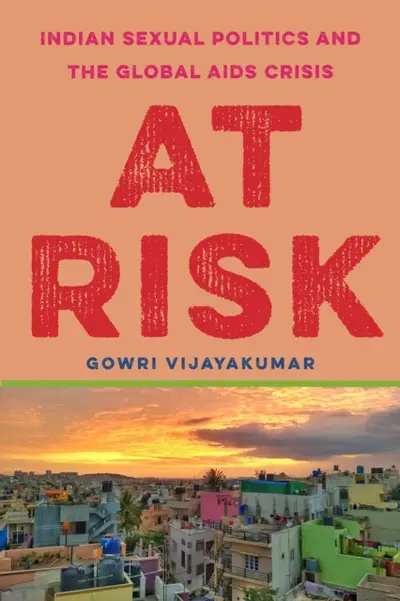
At Risk
Indian Sexual Politics and the Global AIDS Crisis
Price and availability
$28.99
Available in: Andorra, Austria, Australia, Belgium, Bulgaria, Canada, Switzerland, Cyprus, Czechia, Germany, Denmark, Estonia, Spain, Finland, France, United Kingdom, Guernsey, Greece, Croatia, Hungary, Ireland, Isle of Man, Iceland, Italy, Jersey, Japan, Liechtenstein, Lithuania, Luxembourg, Latvia, Monaco, Malta, Netherlands, Norway, Poland, Portugal, Romania, Sweden, Slovenia, Slovakia, San Marino, United States, Vatican City, South Africa
Stores: US, UK, Canada, EU, Australia.
Sign in to buyThe price is re-checked by the server before payment.
For personal use under the eBook licence.
- Format
- DRM
- Not stated by the publisher
- Language
- English
- Publisher
- Stanford University Press
- Published
- 27 July 2021
- ISBN
- 9781503628069
- Subjects
- India, Illness & addiction: social aspects, Gender studies, gender groups, JBFN, JBSF
About this book
In the mid-1990s, experts predicted that India would face the world's biggest AIDS epidemic by 2000. Though a crisis at this scale never fully materialized, global public health institutions, donors, and the Indian state initiated a massive effort to prevent it. HIV prevention programs channeled billions of dollars toward those groups designated as at-risk-sex workers and men who have sex with men. At Risk captures this unique moment in which these criminalized and marginalized groups reinvented their "e;at-risk"e; categorization and became central players in the crisis response. The AIDS crisis created a contradictory, conditional, and temporary opening for sex-worker and LGBTIQ activists to renegotiate citizenship and to make demands on the state. Working across India and Kenya, Gowri Vijayakumar provides a fine-grained account of the political struggles at the heart of the Indian AIDS response. These range from everyday articulations of sexual identity in activist organizations in Bangalore to new approaches to HIV prevention in Nairobi, where prevention strategies first introduced in India are adapted and circulate, as in the global AIDS field more broadly. Vijayakumar illuminates how the politics of gender, sexuality, and nationalism shape global crisis response. In so doing, she considers the precarious potential for social change in and after a crisis.
Bibliographic data © Gardners Books Ltd.