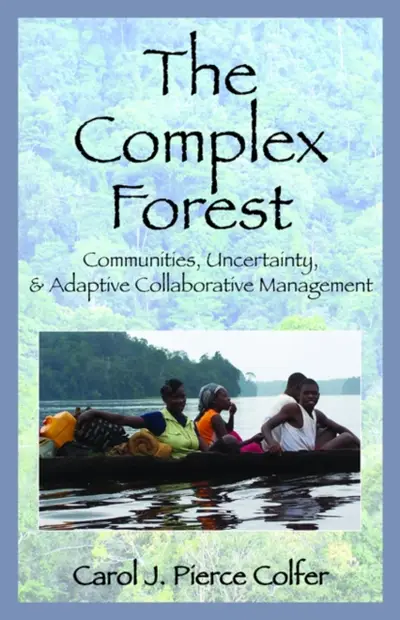
EPUB · English
Complex Forest
Communities, Uncertainty, and Adaptive Collaborative Management
- Society & social sciences
- Economics, business & finance
- Nature, environment & geography
- Technology & engineering
Price and availability
$74.99
Available in: Andorra, Austria, Australia, Belgium, Bulgaria, Canada, Switzerland, Cyprus, Czechia, Germany, Denmark, Estonia, Spain, Finland, France, United Kingdom, Guernsey, Greece, Croatia, Hungary, Ireland, Isle of Man, Iceland, Italy, Jersey, Japan, Liechtenstein, Lithuania, Luxembourg, Latvia, Monaco, Malta, Netherlands, Norway, Poland, Portugal, Romania, Sweden, Slovenia, Slovakia, San Marino, United States, Vatican City, South Africa
Stores: US, UK, Canada, EU, Australia.
Sign in to buyThe price is re-checked by the server before payment.
For personal use under the eBook licence.
- Format
- EPUB
- DRM
- Not stated by the publisher
- Language
- English
- Publisher
- Taylor & Francis
- Published
- 30 September 2010
- ISBN
- 9781136523113
- Subjects
- Forestry & related industries, Forestry & silviculture: practice & techniques, Social and cultural anthropology, Conservation of wildlife and habitats, Forestry and silviculture
About this book
The Complex Forest systematically examines the theory, processes, and early outcomes of a research and management approach called adaptive collaborative management (ACM). An alternative to positivist approaches to development and conservation that assume predictability in forest management, ACM acknowledges the complexity and unpredictability inherent in any forest community and the importance of developing solutions together with the forest peoples whose lives will be most affected by the outcomes. Building on earlier work that established the importance of flexible, collaborative approaches to sustainable forest management, The Complex Forest describes the work of ACM practitioners facing a broad range of challenges in diverse settings and attempts to identify the conditions under which ACM is most effective. Case studies of ACM in 33 forest sites in 11 countries together with Colfer's systematic comparison of results at each site indicate that human and institutional capabilities have been strengthened. In Zimbabwe, for example, the number of women involved in decisionmaking soared. In Nepal, community members detected and sanctioned dishonest community elites. In Cameroon and Bolivia, learning programs resulted in better conflict management. These are early results, but a wide range of recent research supports Colfer's belief that these new capabilities will eventually contribute to higher incomes and to sustainable improvements in the health of forests and forest peoples. The Complex Forest reinforces calls for change in the way we plan conservation and development programs, away from command-and-control approaches, toward ones that require bureaucratic flexibility and responsiveness, as well as greater local participation in setting priorities and problem solving.
Bibliographic data © Gardners Books Ltd.