PDF · English
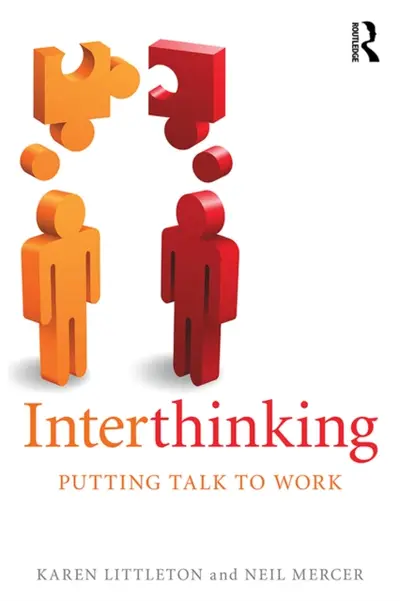
Interthinking: Putting talk to work
Price and availability
$56.99
Available in: Andorra, Austria, Australia, Belgium, Bulgaria, Canada, Switzerland, Cyprus, Czechia, Germany, Denmark, Estonia, Spain, Finland, France, United Kingdom, Guernsey, Greece, Croatia, Hungary, Ireland, Isle of Man, Iceland, Italy, Jersey, Japan, Liechtenstein, Lithuania, Luxembourg, Latvia, Monaco, Malta, Netherlands, Norway, Poland, Portugal, Romania, Sweden, Slovenia, Slovakia, San Marino, United States, Vatican City, South Africa
Stores: US, UK, Canada, EU, Australia.
Sign in to buyThe price is re-checked by the server before payment.
For personal use under the eBook licence.
- Format
- DRM
- Not stated by the publisher
- Language
- English
- Publisher
- Taylor & Francis
- Published
- 15 August 2013
- ISBN
- 9781136675300
- Subjects
- Psychology, Education, Educational psychology, Teaching of a specific subject, Sociolinguistics, Cognition and cognitive psychology, Teaching skills and techniques
About this book
Through using spoken language, people are able to think creatively and productively together. This ability to 'interthink' is an important product of our evolutionary history that is just as important for our survival today. Many kinds of work activity depend on the success of groups or teams finding joint solutions to problems. Creative achievement is rarely the product of solitary endeavour, but of people working within a collective enterprise. Written in an accessible and jargon-free style, Interthinking: putting talk to work explores the growing body of work on how people think creatively and productively together. Challenging purely individualistic accounts of human evolution and cognition, its internationally acclaimed authors provide analyses of real-life examples of collective thinking in everyday settings including workplaces, schools, rehearsal spaces and online environments. The authors use socio-cultural psychology to explain the processes involved in interthinking, to explore its creative power, but also to understand why collective thinking isn't always productive or successful. With this knowledge we can maximise the constructive benefits of our ability to interthink, and understand the best ways in which we can help young people to develop, nurture and value that capability. This book will be of great interest to academic researchers, postgraduates and undergraduates on Education and Psychology courses and to practicing teachers. It will also appeal to anyone with an interest in language, creativity and the role of psychology in everyday life.
Bibliographic data © Gardners Books Ltd.