PDF · English
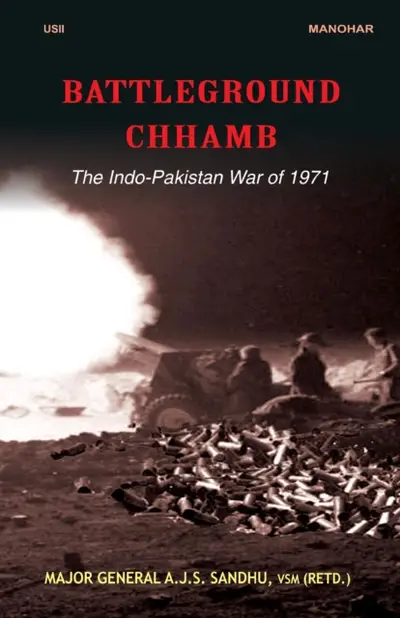
Battleground Chhamb
The Indo-Pakistan War of 1971
Price and availability
$183.99
Available in: Andorra, Austria, Australia, Belgium, Bulgaria, Canada, Switzerland, Cyprus, Czechia, Germany, Denmark, Estonia, Spain, Finland, France, United Kingdom, Guernsey, Greece, Croatia, Hungary, Ireland, Isle of Man, Iceland, Italy, Jersey, Japan, Liechtenstein, Lithuania, Luxembourg, Latvia, Monaco, Malta, Netherlands, Norway, Poland, Portugal, Romania, Sweden, Slovenia, Slovakia, San Marino, United States, Vatican City, South Africa
Stores: US, UK, Canada, EU, Australia.
Sign in to buyThe price is re-checked by the server before payment.
For personal use under the eBook licence.
- Format
- DRM
- Not stated by the publisher
- Language
- English
- Publisher
- Brill
- Published
- 27 October 2025
- ISBN
- 9789004753099
- Subjects
- Sociology, Asia, Society and culture: general
About this book
The Battle of Chhamb is considered to be the fiercest, bloodiest, most intense and decisive battle of the 1971 Indo-Pakistan War. Prime Minister Indira Gandhi termed it as 'the toughest'. Pakistan had amassed a very large and formidable force under 23 Infantry Division for their offensive; it comprised five infantry brigades, one armoured brigade and 31 artillery batteries. In fact the artillery employed by Pakistan in the Chhamb sector was more than they had to defend themselves in East Pakistan (now Bangladesh). Having tasted success in this sector in the 1965 Indo-Pakistan War, this time, with a much larger force, Pakistan hoped to capture the strategically important town of Akhnur. On the other hand, the Indian 10 Infantry Division's task was changed as many as four times in the run up to the war - from a purely Covering Troops action between the Cease Fire Line (CFL) and the permanent defences well to the rear, to an offensive task, then into a 'Forward Poise' and finally to adopt a defensive posture on 1 December 1971. This final change of plan, literally at the eleventh hour, had a profound bearing on the conduct of the battle. Notwithstanding this, 10 Infantry Division fought magnificently and managed to hold the Pakistanis on the line of the Manawar Tawi River. Just as it was preparing to launch major counter-attacks, the sudden declaration of the unilateral ceasefire by India, robbed the division of an opportunity to recapture lost territory. Nor was it taken back during the Shimla negotiations when India held 92,000 Pakistani PoWs in captivity and had the bargaining upper hand. The Battle holds many lessons for India even today and should be required reading not only for members of the defence forces, but for anybody who is interested in South Asian history.
Bibliographic data © Gardners Books Ltd.