EPUB · English
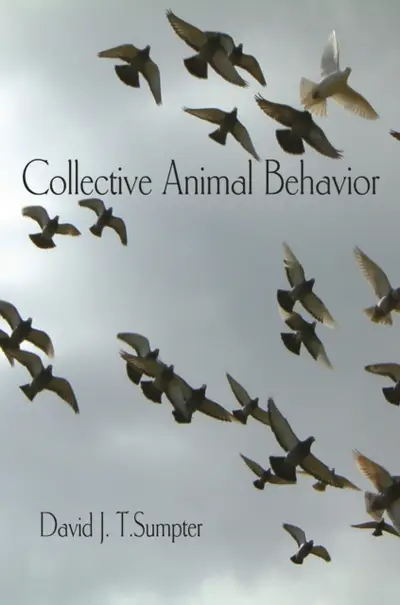
Collective Animal Behavior
Price and availability
$81.99
Available in: Andorra, Austria, Australia, Belgium, Bulgaria, Canada, Switzerland, Cyprus, Czechia, Germany, Denmark, Estonia, Spain, Finland, France, United Kingdom, Guernsey, Greece, Croatia, Hungary, Ireland, Isle of Man, Iceland, Italy, Jersey, Japan, Liechtenstein, Lithuania, Luxembourg, Latvia, Monaco, Malta, Netherlands, Norway, Poland, Portugal, Romania, Sweden, Slovenia, Slovakia, San Marino, United States, Vatican City, South Africa
Stores: US, UK, Canada, EU, Australia.
Sign in to buyThe price is re-checked by the server before payment.
For personal use under the eBook licence.
- Format
- EPUB
- DRM
- Not stated by the publisher
- Language
- English
- Publisher
- Princeton University Press
- Published
- 27 September 2010
- ISBN
- 9781400837106
- Subjects
- Sociology, Biology, life sciences, Animal behaviour, Sociology, Biology, life sciences
About this book
How and why animals produce group behaviorsFish travel in schools, birds migrate in flocks, honeybees swarm, and ants build trails. How and why do these collective behaviors occur? Exploring how coordinated group patterns emerge from individual interactions, Collective Animal Behavior reveals why animals produce group behaviors and examines their evolution across a range of species.Providing a synthesis of mathematical modeling, theoretical biology, and experimental work, David Sumpter investigates how animals move and arrive together, how they transfer information, how they make decisions and synchronize their activities, and how they build collective structures. Sumpter constructs a unified appreciation of how different group-living species coordinate their behaviors and why natural selection has produced these groups. For the first time, the book combines traditional approaches to behavioral ecology with ideas about self-organization and complex systems from physics and mathematics. Sumpter offers a guide for working with key models in this area along with case studies of their application, and he shows how ideas about animal behavior can be applied to understanding human social behavior.Containing a wealth of accessible examples as well as qualitative and quantitative features, Collective Animal Behavior will interest behavioral ecologists and all scientists studying complex systems.
Bibliographic data © Gardners Books Ltd.