PDF · English
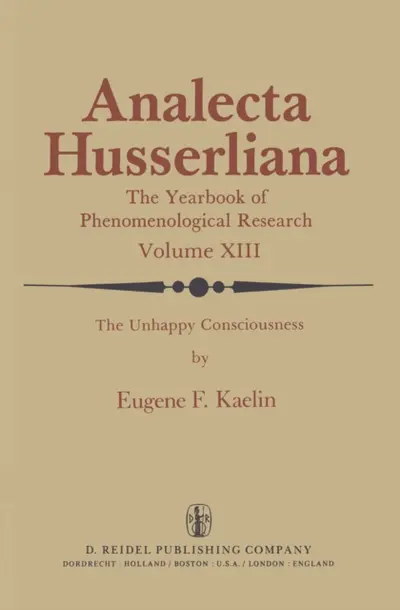
Unhappy Consciousness
The Poetic Plight of Samuel Beckett An Inquiry at the Intersection of Phenomenology and Literature
Price and availability
$175.99
Available in: Andorra, Austria, Australia, Belgium, Bulgaria, Canada, Switzerland, Cyprus, Czechia, Germany, Denmark, Estonia, Spain, Finland, France, United Kingdom, Guernsey, Greece, Croatia, Hungary, Ireland, Isle of Man, Iceland, Italy, Jersey, Japan, Liechtenstein, Lithuania, Luxembourg, Latvia, Monaco, Malta, Netherlands, Norway, Poland, Portugal, Romania, Sweden, Slovenia, Slovakia, San Marino, United States, Vatican City, South Africa
Stores: US, UK, Canada, EU, Australia.
Sign in to buyThe price is re-checked by the server before payment.
For personal use under the eBook licence.
- Format
- DRM
- Not stated by the publisher
- Language
- English
- Publisher
- Springer Netherlands
- Published
- 6 December 2012
- ISBN
- 9789400985223
- Subjects
- linguistics, Semantics, discourse analysis, etc, Phenomenology & Existentialism, Philosophy of science, Semantics, discourse analysis, stylistics, Philosophy of science, Phenomenology and Existentialism
About this book
In the wake of so many other keys to the treasure, whoever undertakes still another book of criticism on the novels and drama of Samuel Beckett must assume the grave burden of justifying the attempt, especially for him who like one of John Barth's recent fictional characterizations of himself, believes that the key to the treasure is the treasure itself. No one will ever have the privilege of the last word on these texts, since any words other than the author's own found therein must be referred back to the text themselves for cautious verification. Indeed, the words the author has used to create the oeuvre stand by virtue of their own creativeness, or fail in their pretense, and need no critical comment to be appreciated for what they have achieved or have failed to achieve. In criticism there is no privileged point of view - not even the author's own. He has consulted his knowledge and experience to make the work, and whoever would criticize his efforts would seem to owe him the indulgence of doing the same. If communication is mediated through the works, the author and his readers respond in recipro- cal fashion to the expressiveness of their contexts. For the philosopher of art, the challenge is extremely tempting - on a manifold count.
Bibliographic data © Gardners Books Ltd.