PDF · English
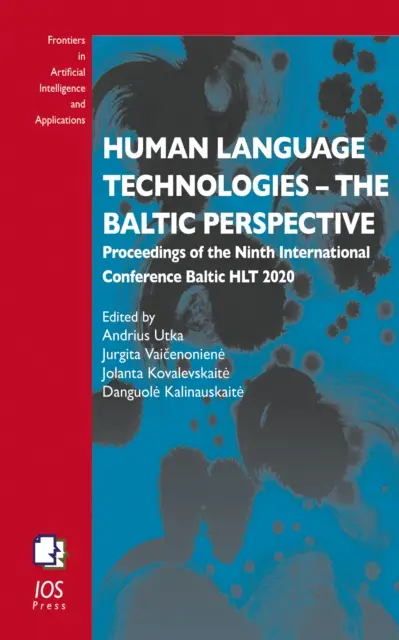
Human Language Technologies - The Baltic Perspective
Proceedings of the Ninth International Conference Baltic HLT 2020
Price and availability
$123.99
Available in: Andorra, Austria, Australia, Belgium, Bulgaria, Canada, Switzerland, Cyprus, Czechia, Germany, Denmark, Estonia, Spain, Finland, France, United Kingdom, Guernsey, Greece, Croatia, Hungary, Ireland, Isle of Man, Iceland, Italy, Jersey, Japan, Liechtenstein, Lithuania, Luxembourg, Latvia, Monaco, Malta, Netherlands, Norway, Poland, Portugal, Romania, Sweden, Slovenia, Slovakia, San Marino, United States, Vatican City, South Africa
Stores: US, UK, Canada, EU, Australia.
Sign in to buyThe price is re-checked by the server before payment.
For personal use under the eBook licence.
- Format
- DRM
- Not stated by the publisher
- Language
- English
- Publisher
- SAGE Publications
- Published
- 15 September 2020
- ISBN
- 9781643681177
- Subjects
- Mathematics & science, Mathematics and Science
About this book
Human language technology is the study of the methods by which computer programs or electronic devices can analyze, produce, modify or respond to human texts and speech. It consists of natural language processing and computational linguistics on the one hand, and speech technology on the other. This book presents the proceedings of the 9th International Conference, Human Language Technologies The Baltic Perspective (Baltic HLT 2020), organised in Kaunas, Lithuania on 22 and 23 September 2020. This biennial conference offers researchers a platform to share knowledge on recent advances in human language processing for the Baltic languages, as well as promoting interdisciplinary and international cooperation in human language-technology research within and beyond the Baltic States. In addition to the traditional topics of natural language processing and language technologies, this year s conference featured a special session on resource and tool development for teaching and learning the less resourced Baltic languages. This year, 42 submissions were received, each of which was evaluated by two reviewers, resulting in a total of 34 papers being accepted for presentation and publication. The book is divided into four sections: speech and text analysis (9 papers); machine translation and natural understanding (6 papers); tools and resources (14 papers); and language learning resources (5 papers). Providing a fascinating overview of current research in the field from a primarily Baltic perspective, the book will be of interest to all those whose work involves human language technology.
Bibliographic data © Gardners Books Ltd.