EPUB · English
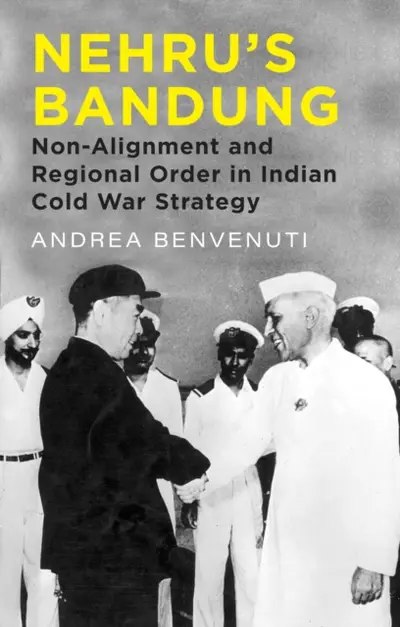
Nehru's Bandung
Non-Alignment and Regional Order in Indian Cold War Strategy
Price and availability
Not sold in this region
Available in: Andorra, Austria, Australia, Belgium, Bulgaria, Switzerland, Cyprus, Czechia, Germany, Denmark, Estonia, Spain, Finland, France, United Kingdom, Guernsey, Greece, Croatia, Hungary, Ireland, Isle of Man, Iceland, Italy, Jersey, Japan, Liechtenstein, Lithuania, Luxembourg, Latvia, Monaco, Malta, Netherlands, Norway, Poland, Portugal, Romania, Sweden, Slovenia, Slovakia, San Marino, Vatican City, South Africa
Stores: UK, EU, Australia. Not available in the United States store.
This title cannot be bought in this store yet: its supplier terms, territorial rights or price are still being confirmed.
For personal use under the eBook licence.
- Format
- EPUB
- DRM
- Not stated by the publisher
- Language
- English
- Publisher
- Hurst Publishers
- Published
- 31 May 2024
- ISBN
- 9781805262343
- Subjects
- India, c 1945 to c 2000 (Post-war period), General & world history, Asian history, Postwar 20th century history, from c 1945 to c 2000, The Cold War, Asian history
About this book
This book sheds light on a neglected aspect ofIndias Cold War diplomacy, starting with therole of Indian Prime Minister Jawaharlal Nehruand his Congress government in organising thefirst Asian-African Conference in Bandung inApril 1955. Andrea Benvenuti shows how, in theearly Cold War, Nehru seized the opportunityaccorded by the conference to transcend growinginternational tensions and pursue an alternativevision: a neutralised Asian area of peace,underpinned by a code of conduct based on thefive principles of peaceful coexistence.Relying on Indian, Western and Chinese archivalsources,Nehrus Bandungfocuses on thepolicy concerns and calculations, as well as theinternational factors, that drove a sceptical Nehruto support Indonesias diplomatic push for such agathering. It reveals how, in Nehrus estimation,Bandung also served a further importantpurposesecuring Chinas commitment topeaceful coexistence, without which stability inAsia would be illusory.Nehrus support for an Asian-African conferencedid not derive from an emotional commitment toAfro-Asian internationalism. Instead, it stemmedfrom a desire to promote a third way in anincreasingly polarised world, and to forge a stableregional orderone that would enhance Indiasexternal security and domestic prosperity.
Bibliographic data © Gardners Books Ltd.