EPUB · English
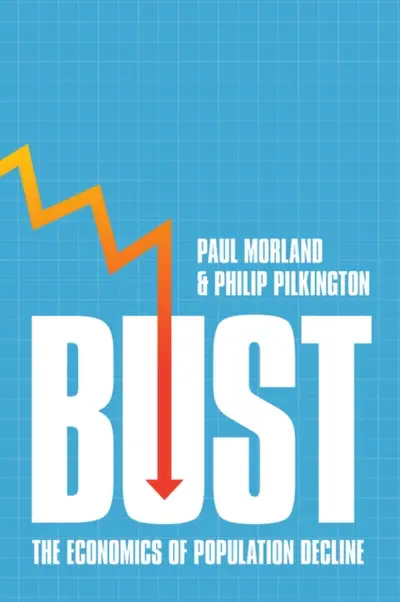
Bust
The Economics of Population Decline
Price and availability
$33.99
Available in: Andorra, Austria, Australia, Belgium, Bulgaria, Canada, Switzerland, Cyprus, Czechia, Germany, Denmark, Estonia, Spain, Finland, France, United Kingdom, Guernsey, Greece, Croatia, Hungary, Ireland, Isle of Man, Iceland, Italy, Jersey, Japan, Liechtenstein, Lithuania, Luxembourg, Latvia, Monaco, Malta, Netherlands, Norway, Poland, Portugal, Romania, Sweden, Slovenia, Slovakia, San Marino, United States, Vatican City, South Africa
Stores: US, UK, Canada, EU, Australia.
Sign in to buyThe price is re-checked by the server before payment.
For personal use under the eBook licence.
- Format
- EPUB
- DRM
- Not stated by the publisher
- Language
- English
- Publisher
- Polity Press
- Published
- 21 October 2026
- ISBN
- 9781509572557
- Subjects
- Sociology & anthropology, Sociology and anthropology
About this book
We are entering an era of population decline across the developed world and beyond. Few have given serious thought to what this might mean economically. Will an ageing society and dwindling population be easily accommodated, or strike at the very heart of our prosperity?Paul Morland and Philip Pilkington argue that the consequences of the coming demographic upheaval will be economically devastating. All of the assumptions of economists that a world of above-replacement birth rates and gentle annual population growth could be taken for granted are being upended. Once economics drove population changes, but now demography is the most fundamental force shaping our economic future. Bust addresses everything from labour and capital markets to housing and the welfare state, showing the profoundly worrying consequences of a shrinking working age population and an ageing society. Unless we take radical action to bolster birth rates, we face a future of falling living standards, high inflation and low growth.This book shines a penetrating light on one of the most ominous and least understood economic and social challenges of the twenty-first century. No-one who reads it will look upon public policy or the future of our society in the same way again.
Bibliographic data © Gardners Books Ltd.