PDF · English
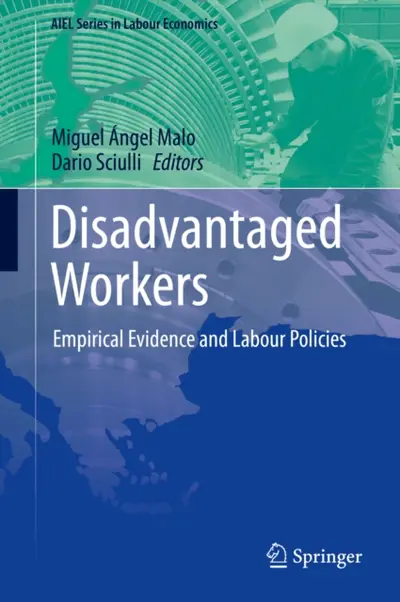
Disadvantaged Workers
Empirical Evidence and Labour Policies
Price and availability
$120.99
Available in: Andorra, Austria, Australia, Belgium, Bulgaria, Canada, Switzerland, Cyprus, Czechia, Germany, Denmark, Estonia, Spain, Finland, France, United Kingdom, Guernsey, Greece, Croatia, Hungary, Ireland, Isle of Man, Iceland, Italy, Jersey, Japan, Liechtenstein, Lithuania, Luxembourg, Latvia, Monaco, Malta, Netherlands, Norway, Poland, Portugal, Romania, Sweden, Slovenia, Slovakia, San Marino, United States, Vatican City, South Africa
Stores: US, UK, Canada, EU, Australia.
Sign in to buyThe price is re-checked by the server before payment.
For personal use under the eBook licence.
- Format
- DRM
- Not stated by the publisher
- Language
- English
- Publisher
- Springer International Publishing
- Published
- 26 March 2014
- ISBN
- 9783319043760
- Subjects
- Central government policies, Labour economics, Political economy, Social welfare, social policy and social services, Regional, state and other local government, Labour / income economics, Political economy
About this book
This book includes empirical contributions focusing on disadvantaged workers. According to the European Commission's definition, disadvantaged workers include categories of workers with difficulties entering the labour market without assistance and hence, requiring the application of public measures aimed at improving their employment opportunities. In addition to the labour market perspective, this is also relevant in terms of social cohesion, which is one of the central objectives of the European Union and of its Member States. This work deals with the most relevant groups of disadvantaged workers, namely disabled workers, young workers, women living in depressed areas, migrants in the labour market and the long-term unemployed, and analyses the situation in the Italian, Spanish and some African labour markets. The determinants of disadvantage in the labour market are investigated, highlighting both the role of supply variables, including structural factors and the weakness on the demand side, the role of the economic crisis and the ineffectiveness of some labour policies. A complex framework emerges in which disadvantaged groups may share common problems, both in terms of integration into the labour market and in terms of working conditions, but often require group-specific policies, taking into account their intergroup heterogeneity.
Bibliographic data © Gardners Books Ltd.