PDF · English
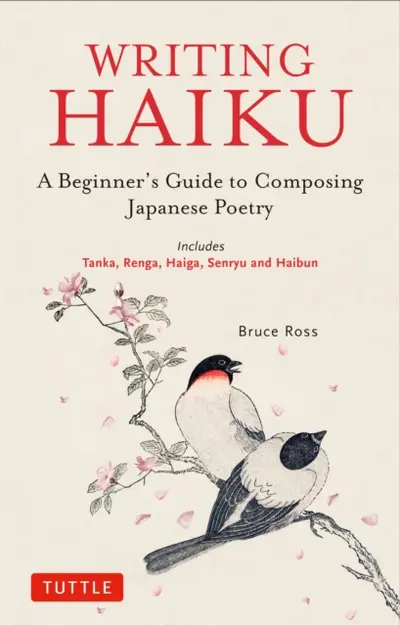
Writing Haiku
A Beginner''s Guide to Composing Japanese Poetry - Includes Tanka, Renga, Haiga, Senryu and Haibun
Price and availability
$20.99
Available in: Andorra, Austria, Australia, Belgium, Bulgaria, Canada, Switzerland, Cyprus, Czechia, Germany, Denmark, Estonia, Spain, Finland, France, United Kingdom, Guernsey, Greece, Croatia, Hungary, Ireland, Isle of Man, Iceland, Italy, Jersey, Japan, Liechtenstein, Lithuania, Luxembourg, Latvia, Monaco, Malta, Netherlands, Norway, Poland, Portugal, Romania, Sweden, Slovenia, Slovakia, San Marino, United States, Vatican City, South Africa
Stores: US, UK, Canada, EU, Australia.
Sign in to buyThe price is re-checked by the server before payment.
For personal use under the eBook licence.
- Format
- DRM
- Not stated by the publisher
- Language
- English
- Publisher
- Tuttle Publishing
- Published
- 15 March 2022
- ISBN
- 9781462923052
- Subjects
- Creative writing & creative writing guides, Literary studies: poetry & poets, Creative writing and creative writing guides, Literary studies: poetry and poets
About this book
A world of dewAnd within every dewdropA world of struggle The iconic three-line haiku form is increasingly popular today as people embrace its simplicity and graceand its connections to the Japanese ethos of mindfulness and minimalism. Say more with fewer words.This practical guide by poet and teacher Bruce Ross shows you how to capture a fleeting moment, like painting a picture with words, and how to give voice to your innermost thoughts, feelings, and observations. You don't have to be a practiced poet or writer to write your own haiku, and this book shows you how.In this book, aspiring poets will find: Accessible, easy-to-replicate examples and writing prompts A foreword that looks at the state of haiku today as the form continues to expand worldwide An introduction to related Japanese haiku forms such as tanka, haiga, renga, haibun, and senryu A listing of international journals and online resourcesDo you want to tell a story? Give haibun a try. Maybe you want to express a fleeting feeling? A tanka is the perfect vehicle. Are you more visual than verbal? Then a haiga, or illustrated haiku, is the ideal match. Finally, a renga is perfect as a group project or to create with friends, passing a poem around, adding line after line, and seeing what your group effort amounts to.Ross walks readers through the history and form of haiku, before laying out what sets each Japanese poetic form apart. Then it's time to turn to your notebook and start drafting some verse of your own!
Bibliographic data © Gardners Books Ltd.