EPUB · English
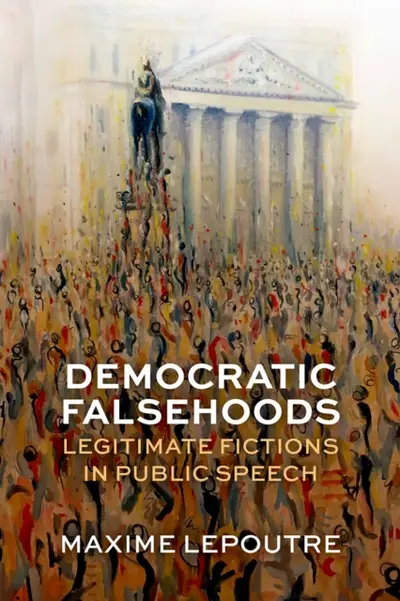
Democratic Falsehoods
Legitimate Fictions in Public Speech
Price and availability
$59.99
Available in: Andorra, Austria, Australia, Belgium, Bulgaria, Canada, Switzerland, Cyprus, Czechia, Germany, Denmark, Estonia, Spain, Finland, France, United Kingdom, Guernsey, Greece, Croatia, Hungary, Ireland, Isle of Man, Iceland, Italy, Jersey, Japan, Liechtenstein, Lithuania, Luxembourg, Latvia, Monaco, Malta, Netherlands, Norway, Poland, Portugal, Romania, Sweden, Slovenia, Slovakia, San Marino, United States, Vatican City, South Africa
Stores: US, UK, Canada, EU, Australia.
Sign in to buyThe price is re-checked by the server before payment.
For personal use under the eBook licence.
- Format
- EPUB
- DRM
- Not stated by the publisher
- Language
- English
- Publisher
- Oxford University Press
- Published
- 6 February 2026
- ISBN
- 9780198916000
- Subjects
- Social & political philosophy, Media studies, Political science & theory, Elections & referenda, Political science and theory, Elections and referenda / suffrage, Social and political philosophy
About this book
Falsehoods can gravely endanger democratic societies. When disinformation circulates widely, it can alter the outcome of elections, erode trust in democratic institutions, undermine support for critically important policies, or even incite violence. It is therefore natural to conclude that falsehoods should have no place whatsoever in democratic life. Democratic Falsehoods argues that this conclusion is nevertheless too quick. Although many falsehoods pose a clear and serious democratic threat, other falsehoods are more benign, and others still can play an actively positive role within democratic public discourse. This book explores how falsehoods can contribute to performing key functions of democratic public discourse, such as countering hate speech, mobilising collective action, supporting just wars of self-defence, representing constituents, or even promoting public understanding of pressing scientific matters. Can falsehoods advance, rather than hinder, such goals? Under what conditions are they likely to do so? And when, if ever, is it permissible to deploy such falsehoods in a democratic society? By investigating these questions, Democratic Falsehoods aims to show that falsehoods can sometimes play a legitimate role in democratic public life. It demonstrates, moreover, that some falsehoods are legitimate, not in spite of, but precisely because of our commitment to democracy. Finally, but crucially, it provides a comprehensive account of how these falsehoods differ from-and, indeed, can help to counteract-the dangerous falsehoods plaguing contemporary democracies.
Bibliographic data © Gardners Books Ltd.