PDF · English
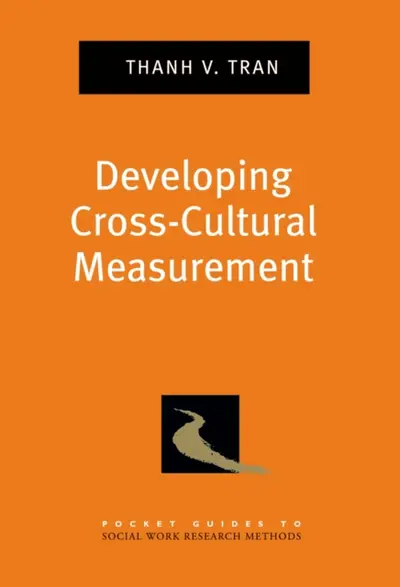
Developing Cross-Cultural Measurement
Price and availability
$29.99
Available in: Andorra, Austria, Australia, Belgium, Bulgaria, Canada, Switzerland, Cyprus, Czechia, Germany, Denmark, Estonia, Spain, Finland, France, United Kingdom, Guernsey, Greece, Croatia, Hungary, Ireland, Isle of Man, Iceland, Italy, Jersey, Japan, Liechtenstein, Lithuania, Luxembourg, Latvia, Monaco, Malta, Netherlands, Norway, Poland, Portugal, Romania, Sweden, Slovenia, Slovakia, San Marino, United States, Vatican City, South Africa
Stores: US, UK, Canada, EU, Australia.
Sign in to buyThe price is re-checked by the server before payment.
For personal use under the eBook licence.
- Format
- DRM
- Not stated by the publisher
- Language
- English
- Publisher
- Oxford University Press
- Published
- 27 March 2009
- ISBN
- 9780199724048
- Subjects
- Social research & statistics, Social work, Social research and statistics, Social work
About this book
Social workers engage in cross-cultural research in order to understand how diverse populations cope with life situations, to identify risk and protective factors across cultures, and to evaluate the effectiveness of policies and programs on the well-being of individuals from different cultures. In order to do so, it is necessary to begin with meaningful, appropriate, and practical research instruments, yet such instruments are not always readily available, or they may be misleading or biased. In this clearly written pocket guide, social work researchers will find a concise, easy-to-follow explanation of how to develop and assess cross-cultural measures that sidestep such complications and provide reliable, valid data. Using a step-by-step approach, expert cross-cultural researcher Thanh V. Tran carefully explores the issues and methodology in cross-cultural measurement development in social work research and evaluation. The book draws on existing cross-cultural research in social sciences and related areas to illustrate how to formulate research questions, select observable statistics, understand cross-cultural translation, evaluate and implement measurement equivalence, and discern quality within practices of measurement development. Tran also discusses how to use statistics software programs such as SPSS to generate data for LISREL analyses, providing enough detail to help readers grasp the programs' applications in this area but not so much as to overwhelm. This concise text offers a wealth of knowledge about using and interpreting the use of culturally relevant research instruments. Doctoral students and social researchers in the field seeking guidance in selecting and adapting such instruments in their studies, or developing and assessing their own, will find it a terrific source of essential information for their work. For additional resources, visit http://www.oup.com/us/pocketguides.
Bibliographic data © Gardners Books Ltd.