EPUB · English
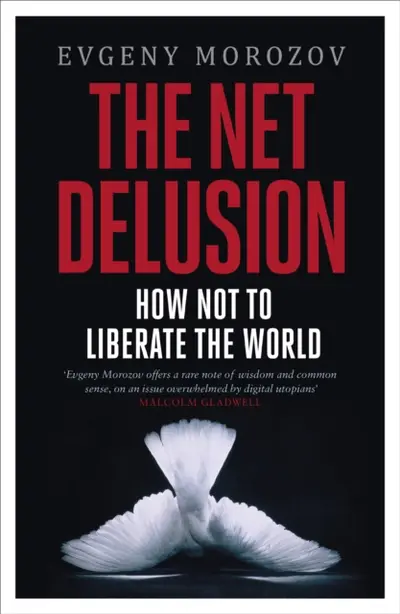
Net Delusion
How Not to Liberate The World
Price and availability
Not sold in this region
Available in: Andorra, Austria, Australia, Belgium, Bulgaria, Switzerland, Cyprus, Czechia, Germany, Denmark, Estonia, Spain, Finland, France, United Kingdom, Guernsey, Greece, Croatia, Hungary, Ireland, Isle of Man, Iceland, Italy, Jersey, Japan, Liechtenstein, Lithuania, Luxembourg, Latvia, Monaco, Malta, Netherlands, Norway, Poland, Portugal, Romania, Sweden, Slovenia, Slovakia, San Marino, Vatican City, South Africa
Stores: UK, EU, Australia. Not available in the United States store.
This title cannot be bought in this store yet: its supplier terms, territorial rights or price are still being confirmed.
For personal use under the eBook licence.
- Format
- EPUB
- DRM
- Not stated by the publisher
- Language
- English
- Publisher
- Penguin Books Ltd
- Published
- 6 January 2011
- ISBN
- 9780141961828
- Subjects
- Regional & national history, Ethical issues: censorship, Freedom of information & freedom of speech, Impact of science & technology on society, Ethical & social aspects of IT, Human rights, civil rights, General and world history, Impact of science and technology on society
About this book
Does free information mean free people?At the start of the twenty-first century we were promised that the internet would liberate the world. We could come together as never before, and from Iran's 'twitter revolution' to Facebook 'activism', technological innovationwould spread democracy to oppressed peoples everywhere.We couldn't have been more wrong. In The Net Delusion Evgeny Morozov destroys this myth, arguing that 'internet freedom' is an illusion, and that technology has failed to help protect people's rights. Not only that - in many cases the internet is actually helping authoritarian regimes. From China to Russia to Iran, oppressive governments are using cyberspace to stifle dissent: planting clandestine propaganda, employing sophisticated digital censorship andusing online surveillance. We are all being manipulated in more subtle ways too - becoming pacified by the net, instead of truly engaging.This book is a wake-up call. It shows us how our misplaced faith in cyber-utopia means the West risks missing the real challenges. Morozov argues that we must look at other ways of promoting democracy abroad, and forces us - policymakers and citizens alike - to recognize that all our freedoms are at stake.
Bibliographic data © Gardners Books Ltd.