PDF · English
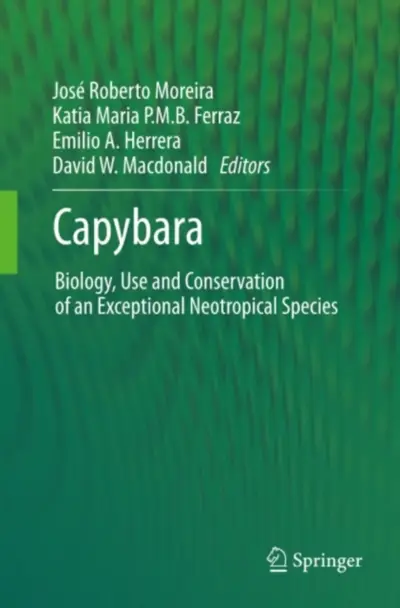
Capybara
Biology, Use and Conservation of an Exceptional Neotropical Species
Price and availability
$269.99
Available in: Andorra, Austria, Australia, Belgium, Bulgaria, Canada, Switzerland, Cyprus, Czechia, Germany, Denmark, Estonia, Spain, Finland, France, United Kingdom, Guernsey, Greece, Croatia, Hungary, Ireland, Isle of Man, Iceland, Italy, Jersey, Japan, Liechtenstein, Lithuania, Luxembourg, Latvia, Monaco, Malta, Netherlands, Norway, Poland, Portugal, Romania, Sweden, Slovenia, Slovakia, San Marino, United States, Vatican City, South Africa
Stores: US, UK, Canada, EU, Australia.
Sign in to buyThe price is re-checked by the server before payment.
For personal use under the eBook licence.
- Format
- DRM
- Not stated by the publisher
- Language
- English
- Publisher
- Springer New York
- Published
- 16 August 2012
- ISBN
- 9781461440000
- Subjects
- Latin America, Zoology: Mammals, Conservation of the environment, Ecological science, the Biosphere, Zoology and animal sciences, Conservation of the environment, Animal husbandry
About this book
The capybara is the neotropical mammal with the highest potential for production and domestication. Amongst the favorable characteristics for domestication we can list its high prolificacy, rapid growth rate, a herbivorous diet, social behavior and relative tameness. The genus (with only two species) is found from the Panama Canal to the north of Argentina on the east of the Andes. Chile is the only country in South America where the capybara is not found. The species is eaten all over its range, especially by poor, rural and traditional communities engaged in subsistence hunting. On the other hand, in large urban settlements wildlife is consumed by city dwellers as a delicacy. The sustainable management of capybara in the wild has been adopted by some South American countries, while others have encouraged capybara rearing in captivity.
Bibliographic data © Gardners Books Ltd.