PDF · English
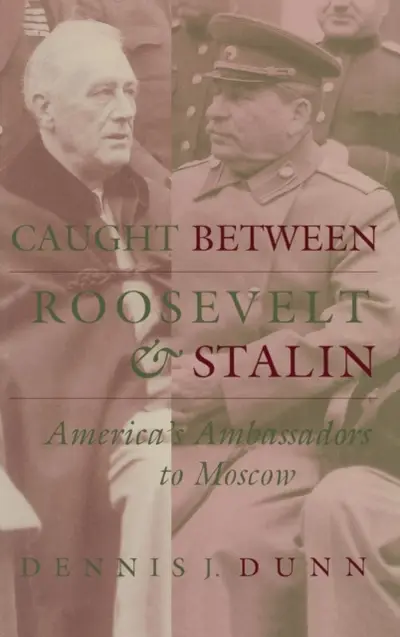
Caught between Roosevelt and Stalin
America's Ambassadors to Moscow
Price and availability
$54.99
Available in: Andorra, Austria, Australia, Belgium, Bulgaria, Canada, Switzerland, Cyprus, Czechia, Germany, Denmark, Estonia, Spain, Finland, France, United Kingdom, Guernsey, Greece, Croatia, Hungary, Ireland, Isle of Man, Iceland, Italy, Jersey, Japan, Liechtenstein, Lithuania, Luxembourg, Latvia, Monaco, Malta, Netherlands, Norway, Poland, Portugal, Romania, Sweden, Slovenia, Slovakia, San Marino, United States, Vatican City, South Africa
Stores: US, UK, Canada, EU, Australia.
Sign in to buyThe price is re-checked by the server before payment.
For personal use under the eBook licence.
- Format
- DRM
- Not stated by the publisher
- Language
- English
- Publisher
- The University Press of Kentucky
- Published
- 17 October 2014
- ISBN
- 9780813158839
- Subjects
- USA, History of the Americas, International relations, Diplomacy, International relations, Diplomacy, History of the Americas
About this book
On November 16, 1933, Franklin D. Roosevelt and Soviet Commissar of Foreign Affairs Maxim Litvinov signed an agreement establishing diplomatic ties between the United States and the Soviet Union. Two days later Roosevelt named the first of five ambassadors he would place in Moscow between 1933 and 1945. Caught between Roosevelt and Stalin tells the dramatic and important story of these ambassadors and their often contentious relationships with the two most powerful men in the world.More than fifty years after his death, Roosevelt's foreign policy, especially regarding the Soviet Union, remains a subject of intense debate. Dennis Dunn offers an ambitious new appraisal of the apparent confusion and contradiction in Roosevelt's policy one moment publicizing the four freedoms and the Atlantic Charter and the next moment giving tacit approval to Stalin's control of parts of Eastern Europe and northeast Asia.Dunn argues that "Rooseveltism," the president's belief that the Soviet Union and the United States were both developing into modern social democracies, blinded Roosevelt to the true nature of Stalin's brutal dictatorship despite repeated warnings from his ambassadors in Moscow. Focusing on the ambassadors themselves, William C. Bullitt, Joseph E. Davies, Laurence A. Steinhardt, William C. Standley, and W. Averell Harriman, Dunn details their bruising arguments with Roosevelt over the president's repeated concessions to Stalin.Using information uncovered during extensive research in the Soviet archives, Dunn reveals much about Stalin's policy toward the United States and demonstrates that in ignoring his ambassadors' good advice, Roosevelt appeased the Soviet leader unnecessarily. Sure to generate new discussion concerning the origins of the Cold War, this controversial assessment of Roosevelt's failed Soviet policy will be read for years to come.
Bibliographic data © Gardners Books Ltd.