EPUB · English
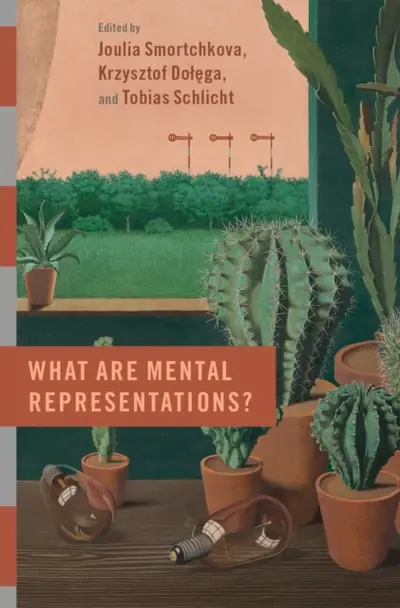
What are Mental Representations?
Price and availability
$93.99
Available in: Andorra, Austria, Australia, Belgium, Bulgaria, Canada, Switzerland, Cyprus, Czechia, Germany, Denmark, Estonia, Spain, Finland, France, United Kingdom, Guernsey, Greece, Croatia, Hungary, Ireland, Isle of Man, Iceland, Italy, Jersey, Japan, Liechtenstein, Lithuania, Luxembourg, Latvia, Monaco, Malta, Netherlands, Norway, Poland, Portugal, Romania, Sweden, Slovenia, Slovakia, San Marino, United States, Vatican City, South Africa
Stores: US, UK, Canada, EU, Australia.
Sign in to buyThe price is re-checked by the server before payment.
For personal use under the eBook licence.
- Format
- EPUB
- DRM
- Not stated by the publisher
- Language
- English
- Publisher
- Oxford University Press
- Published
- 28 September 2020
- ISBN
- 9780190686697
- Subjects
- Philosophy, Philosophy of mind, Physiological & neuro-psychology, biopsychology, Cognition & cognitive psychology, Perception, Physiological psychology, neuropsychology, biopsychology, Cognition and cognitive psychology, QD, QDTM
About this book
The topic of this book is mental representation, a theoretical concept that lies at the core of cognitive science. Together with the idea that thinking is analogous to computational processing, this concept is responsible for the "e;cognitive turn"e; in the sciences of the mind and brain since the 1950s. Conceiving of cognitive processes (such as perception, reasoning, and motor control) as consisting of the manipulation of contentful vehicles that represent the world has led to tremendous empirical advancements in our explanations of behaviour. Perhaps the most famous discovery that explains behavior by appealing to the notion of mental representations was the discovery of 'place' cells that underlie spatial navigation and positioning, which earned researchers John O'Keefe, May-Britt Moser, and Edvard I. Moser a joint Nobel Prize in 2014. And yet, despite the empirical importance of the concept, there is no agreed definition or theoretical understanding of mental representation. This book constitutes a state-of-the-art overview on the topic of mental representation, assembling some of the leading experts in the field and allowing them to engage in meaningful exchanges over some of the most contentious questions. The collection gathers both proponents and critics of the notion, making room for debates dealing with the theoretical and ontological status of representations, the possibility of formulating a general account of mental representation which would fit our best explanatory practices, and the possibility of delivering such an account in fully naturalistic terms. Some contributors explore the relation between mutually incompatible notions of mental representation, stemming from the different disciplines composing the cognitive sciences (such as neuroscience, psychology, and computer science). Others question the ontological status and explanatory usefulness of the notion. And finally, some try to sketch a general theory of mental representations that could face the challenges outlined in the more critical chapters of the volume.
Bibliographic data © Gardners Books Ltd.