EPUB · English
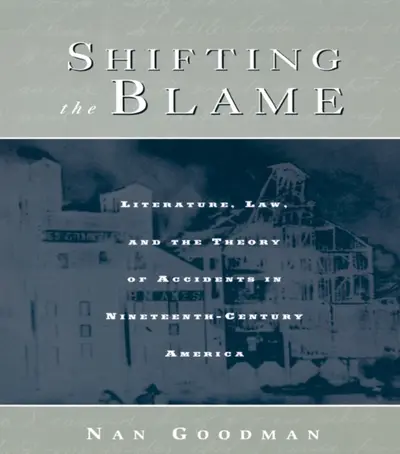
Shifting the Blame
Literature, Law, and the Theory of Accidents in Nineteenth Century America
Price and availability
$59.99
Available in: Andorra, Austria, Australia, Belgium, Bulgaria, Canada, Switzerland, Cyprus, Czechia, Germany, Denmark, Estonia, Spain, Finland, France, United Kingdom, Guernsey, Greece, Croatia, Hungary, Ireland, Isle of Man, Iceland, Italy, Jersey, Japan, Liechtenstein, Lithuania, Luxembourg, Latvia, Monaco, Malta, Netherlands, Norway, Poland, Portugal, Romania, Sweden, Slovenia, Slovakia, San Marino, United States, Vatican City, South Africa
Stores: US, UK, Canada, EU, Australia.
Sign in to buyThe price is re-checked by the server before payment.
For personal use under the eBook licence.
- Format
- EPUB
- DRM
- Not stated by the publisher
- Language
- English
- Publisher
- Taylor & Francis
- Published
- 16 December 2013
- ISBN
- 9781136693489
- Subjects
- USA, Ancient (Classical) Greek, c 1800 to c 1900, Literary studies: general, Literary studies: c 1800 to c 1900, Regional studies, History of the Americas, Modern history to 20th century: c 1700 to c 1900, Social & cultural history, Legal history, United States of America, USA, Literary studies: fiction, novelists and prose writers, Legal history, Social and cultural history
About this book
When someone gets hurt in an accident we reflexively ask a set of questions which ultimately comes down to who was blameworthy? Yet early nineteenth-century Americans were entirely, and to the modern reader, astonishingly, uninterested in this line of reasoning. Their concern was whether an accident had happened and not why. Nan Goodman takes this transformation in legal and popular thought about the nature of accidents as a starting point for a broad inquiry into changing conceptions of individual agency-and ultimately of self-in industrializing America. Goodman looks to both conventional historical sources and the literary depiction of accidents in the work of Mark Twain, Stephen Crane, Charles Chesnutt, and others to explain the new ways that Americans began to make sense of the unplanned.
Bibliographic data © Gardners Books Ltd.