PDF · English
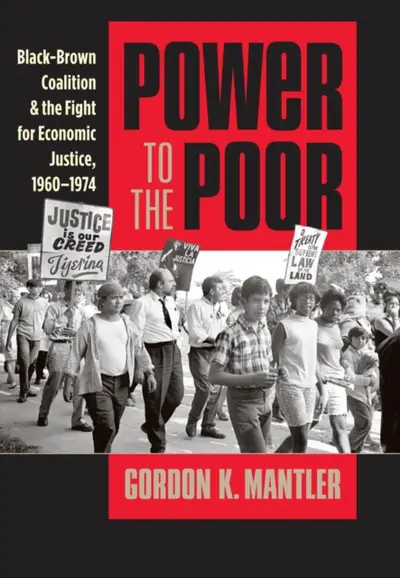
Power to the Poor
Black-Brown Coalition and the Fight for Economic Justice, 1960-1974
Price and availability
$91.99
Available in: Andorra, Austria, Australia, Belgium, Bulgaria, Canada, Switzerland, Cyprus, Czechia, Germany, Denmark, Estonia, Spain, Finland, France, United Kingdom, Guernsey, Greece, Croatia, Hungary, Ireland, Isle of Man, Iceland, Italy, Jersey, Japan, Liechtenstein, Lithuania, Luxembourg, Latvia, Monaco, Malta, Netherlands, Norway, Poland, Portugal, Romania, Sweden, Slovenia, Slovakia, San Marino, United States, Vatican City, South Africa
Stores: US, UK, Canada, EU, Australia.
Sign in to buyThe price is re-checked by the server before payment.
For personal use under the eBook licence.
- Format
- DRM
- Not stated by the publisher
- Language
- English
- Publisher
- The University of North Carolina Press
- Published
- 25 February 2013
- ISBN
- 9781469608075
- Subjects
- USA, History of the Americas, Ethnic minorities & multicultural studies, Black & Asian studies, Hispanic & Latino studies, Political activism, United States of America, USA, Ethnic studies / Ethnicity, History of the Americas
About this book
The Poor Peoples Campaign of 1968 has long been overshadowed by the assassination of its architect, Dr. Martin Luther King Jr., and the political turmoil of that year. In a major reinterpretation of civil rights and Chicano movement history, Gordon K. Mantler demonstrates how Kings unfinished crusade became the eras most high-profile attempt at multiracial collaboration and sheds light on the interdependent relationship between racial identity and political coalition among African Americans and Mexican Americans. Mantler argues that while the fight against poverty held great potential for black-brown cooperation, such efforts also exposed the complex dynamics between the nations two largest minority groups.Drawing on oral histories, archives, periodicals, and FBI surveillance files, Mantler paints a rich portrait of the campaign and the larger antipoverty work from which it emerged, including the labor activism of Cesar Chavez, opposition of Black and Chicano Power to state violence in Chicago and Denver, and advocacy for Mexican American land-grant rights in New Mexico. Ultimately, Mantler challenges readers to rethink the multiracial history of the long civil rights movement and the difficulty of sustaining political coalitions.
Bibliographic data © Gardners Books Ltd.