EPUB · English
Secret Science
A Century of Poison Warfare and Human Experiments
Price and availability
$18.99
Available in: Andorra, Austria, Australia, Belgium, Bulgaria, Canada, Switzerland, Cyprus, Czechia, Germany, Denmark, Estonia, Spain, Finland, France, United Kingdom, Guernsey, Greece, Croatia, Hungary, Ireland, Isle of Man, Iceland, Italy, Jersey, Japan, Liechtenstein, Lithuania, Luxembourg, Latvia, Monaco, Malta, Netherlands, Norway, Poland, Portugal, Romania, Sweden, Slovenia, Slovakia, San Marino, United States, Vatican City, South Africa
Stores: US, UK, Canada, EU, Australia.
Sign in to buyThe price is re-checked by the server before payment.
For personal use under the eBook licence.
- Format
- EPUB
- DRM
- Not stated by the publisher
- Language
- English
- Publisher
- Oxford University Press
- Published
- 8 July 2015
- ISBN
- 9780191062971
- Subjects
- 20th century, 21st century, General & world history, 20th century history: c 1900 to c 2000, 21st century history: from c 2000 -, Military history, Political control & freedoms, Chemical & biological weapons, History of medicine, Political control and freedoms, Chemical and biological weapons, History of medicine, General and world history, Modern warfare
About this book
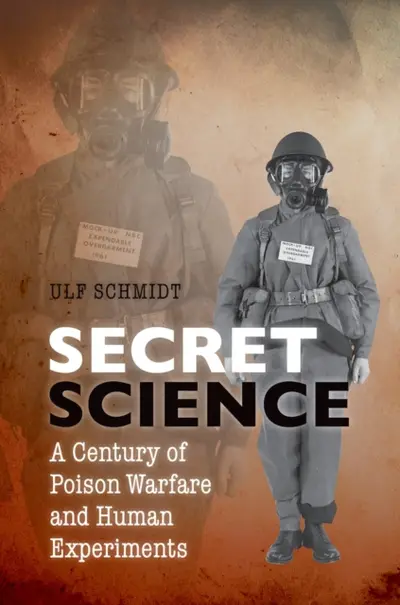
From the early 1990s, allegations that servicemen had been duped into taking part in trials with toxic agents at top-secret Allied research facilities throughout the twentieth century featured with ever greater frequency in the media. In Britain, a whole army of over 21,000 soldiers had participated in secret experiments between 1939 and 1989. Some remembered their stay as harmless, but there were many for whom the experience had been all but pleasant, sometimes harmful, and in isolated cases deadly. Secret Science traces, for the first time, the history of chemical and biological weapons research by the former Allied powers, particularly in Britain, the United States, and Canada. It charts the ethical trajectory and culture of military science, from its initial development in response to Germany's first use of chemical weapons in the First World War to the ongoing attempts by the international community to ban these types of weapons once and for all. It asks whether Allied and especially British warfare trials were ethical, safe, and justified within the prevailing conditions and values of the time. By doing so, it helps to explain the complex dynamics in top-secret Allied research establishments: the desire and ability of the chemical and biological warfare corps, largely comprised of military officials, scientists, and expert civil servants, to construct and identify a never-ending stream of national security threats which served as flexible justification strategies for the allocation of enormous resources to conducting experimental research with some of the most deadly agents known to man. Secret Science offers a nuanced, non-judgemental analysis of the contributions made by servicemen, scientists, and civil servants to military research in Britain and elsewhere, not as passive, helpless victims 'without voices', or as laboratory and desk perpetrators 'without a conscience', but as history's actors and agents of their own destiny. As such it also makes an important contribution to the burgeoning literature on the history and culture of memory.
Bibliographic data © Gardners Books Ltd.