EPUB · English
Kenosis Creativity Architecture
Appearance through Emptying
Price and availability
$59.99
Available in: Andorra, Austria, Australia, Belgium, Bulgaria, Canada, Switzerland, Cyprus, Czechia, Germany, Denmark, Estonia, Spain, Finland, France, United Kingdom, Guernsey, Greece, Croatia, Hungary, Ireland, Isle of Man, Iceland, Italy, Jersey, Japan, Liechtenstein, Lithuania, Luxembourg, Latvia, Monaco, Malta, Netherlands, Norway, Poland, Portugal, Romania, Sweden, Slovenia, Slovakia, San Marino, United States, Vatican City, South Africa
Stores: US, UK, Canada, EU, Australia.
Sign in to buyThe price is re-checked by the server before payment.
For personal use under the eBook licence.
- Format
- EPUB
- DRM
- Not stated by the publisher
- Language
- English
- Publisher
- Taylor & Francis
- Published
- 21 March 2021
- ISBN
- 9781000347722
- Subjects
- Architecture, Theory of architecture, Religious buildings, History of architecture, Philosophy: aesthetics, Philosophy of religion, Ancient Greek religion & mythology, Theology, Civil engineering, surveying & building, World, Theory of architecture, Individual architects and architectural firms, Philosophical traditions and schools of thought, Theology
About this book
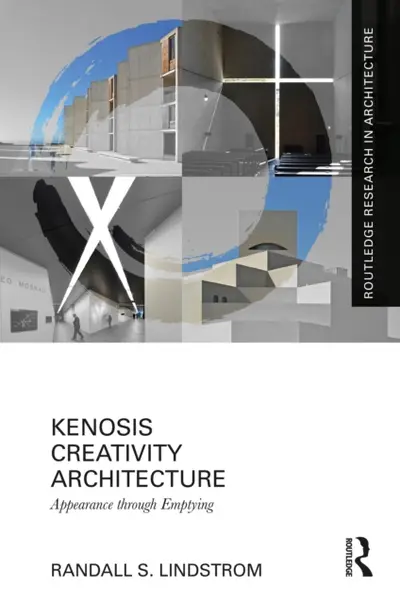
Kenosis Creativity Architecture locates and explores creativity's grounding in the ancient concept of kenosis, the "e;emptying"e; that allows creativity to happen; that makes appearance possible.It concretises that grounding through architecture-a primal expression of human creativity-critically examining, for the first time, kenotic instantiations evidenced in four iconic, international projects; works by Kahn, Pei, Ando, and Libeskind. Then, in a final turn, the potentiality of architecture's own emptying is probed. Architect and author Randall Lindstrom draws on Western and Eastern philosophy, including that of Heidegger, Levinas, Derrida, Vattimo, Nishida, and Nishitani, as well as on the theology of Christianity, Judaism, and aspects of Buddhism, Hinduism, and Islam. Every chapter expands the argument that, if responsiveness to our world is taken seriously-if proper and sustainable responses are to be realised-then a deeper understanding of creativity, and so kenosis, is essential.This book opens-up a way of thinking about creativity and humanity's readiness to be creative. It thereby presents a crucial enquiry-at the nexus of architecture, philosophy, and theology-for researchers, graduate and postgraduate students, and practitioners alike.
Bibliographic data © Gardners Books Ltd.