PDF · English
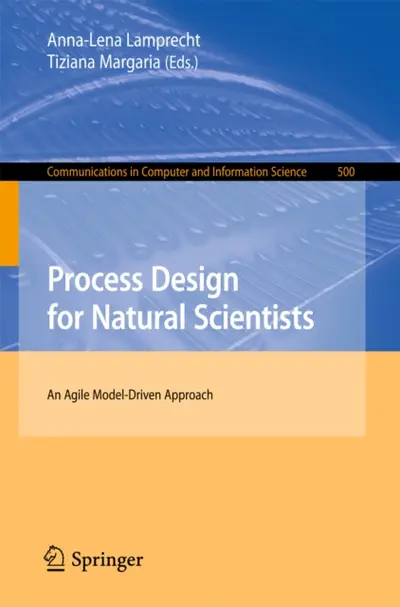
Process Design for Natural Scientists
An Agile Model-Driven Approach
Price and availability
$60.99
Available in: Andorra, Austria, Australia, Belgium, Bulgaria, Canada, Switzerland, Cyprus, Czechia, Germany, Denmark, Estonia, Spain, Finland, France, United Kingdom, Guernsey, Greece, Croatia, Hungary, Ireland, Isle of Man, Iceland, Italy, Jersey, Japan, Liechtenstein, Lithuania, Luxembourg, Latvia, Monaco, Malta, Netherlands, Norway, Poland, Portugal, Romania, Sweden, Slovenia, Slovakia, San Marino, United States, Vatican City, South Africa
Stores: US, UK, Canada, EU, Australia.
Sign in to buyThe price is re-checked by the server before payment.
For personal use under the eBook licence.
- Format
- DRM
- Not stated by the publisher
- Language
- English
- Publisher
- Springer Berlin Heidelberg
- Published
- 19 September 2014
- ISBN
- 9783662450062
- Subjects
- Business applications, 3D graphics & modelling, Software Engineering, Databases, Information retrieval, Computer science, Software Engineering, Databases / Data management, Applied computing, Mathematical theory of computation, Computer modelling and simulation
About this book
This book presents an agile and model-driven approach to manage scientific workflows. The approach is based on the Extreme Model Driven Design (XMDD) paradigm and aims at simplifying and automating the complex data analysis processes carried out by scientists in their day-to-day work. Besides documenting the impact the workflow modeling might have on the work of natural scientists, this book serves three major purposes: 1. It acts as a primer for practitioners who are interested to learn how to think in terms of services and workflows when facing domain-specific scientific processes. 2. It provides interesting material for readers already familiar with this kind of tools, because it introduces systematically both the technologies used in each case study and the basic concepts behind them. 3. As the addressed thematic field becomes increasingly relevant for lectures in both computer science and experimental sciences, it also provides helpful material for teachers that plan similar courses.
Bibliographic data © Gardners Books Ltd.