PDF · English
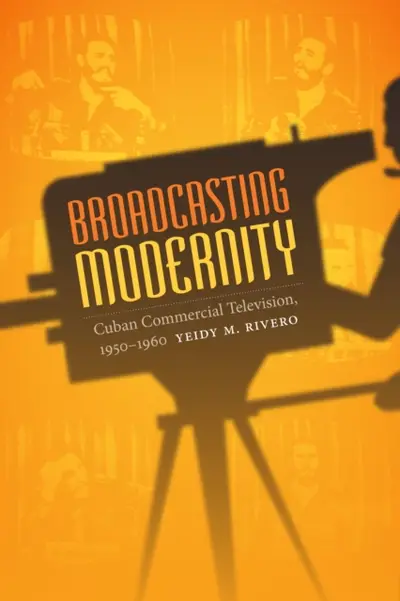
Broadcasting Modernity
Cuban Commercial Television, 1950-1960
Price and availability
$47.99
Available in: Andorra, Austria, Australia, Belgium, Bulgaria, Canada, Switzerland, Cyprus, Czechia, Germany, Denmark, Estonia, Spain, Finland, France, United Kingdom, Guernsey, Greece, Croatia, Hungary, Ireland, Isle of Man, Iceland, Italy, Jersey, Japan, Liechtenstein, Lithuania, Luxembourg, Latvia, Monaco, Malta, Netherlands, Norway, Poland, Portugal, Romania, Sweden, Slovenia, Slovakia, San Marino, United States, Vatican City, South Africa
Stores: US, UK, Canada, EU, Australia.
Sign in to buyThe price is re-checked by the server before payment.
For personal use under the eBook licence.
- Format
- DRM
- Not stated by the publisher
- Language
- English
- Publisher
- Duke University Press
- Published
- 19 April 2015
- ISBN
- 9780822375685
- Subjects
- Cuba, c 1945 to c 1960, Television, History of the Americas, Media studies, Radio & television industry, Cuba, 3MPQM, ATJ, JBCT, KNTC, NHK
About this book
The birth and development of commercial television in Cuba in the 1950s occurred alongside political and social turmoil. In this period of dramatic swings encompassing democracy, a coup, a dictatorship, and a revolution, television functioned as a beacon and promoter of Cuba's identity as a modern nation. In Broadcasting Modernity, television historian Yeidy M. Rivero shows how television owners, regulatory entities, critics, and the state produced Cuban modernity for television. The Cuban television industry enabled different institutions to convey the nation's progress, democracy, economic abundance, high culture, education, morality, and decency. After nationalizing Cuban television, the state used it to advance Fidel Castro's project of creating a modern socialist country. As Cuba changed, television changed with it. Rivero not only demonstrates television's importance to Cuban cultural identity formation, she explains how the medium functions in society during times of radical political and social transformation.
Bibliographic data © Gardners Books Ltd.