PDF · English
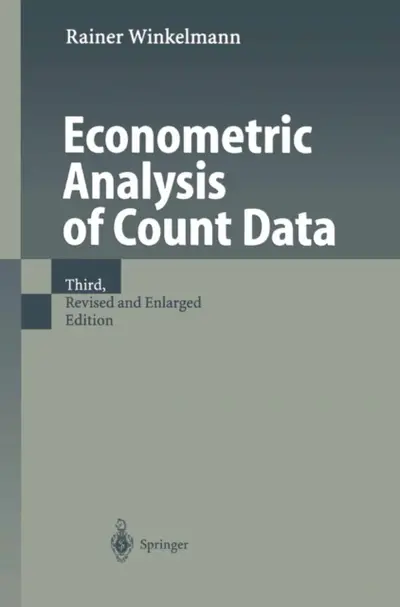
Econometric Analysis of Count Data
Price and availability
$97.99
Available in: Andorra, Austria, Australia, Belgium, Bulgaria, Canada, Switzerland, Cyprus, Czechia, Germany, Denmark, Estonia, Spain, Finland, France, United Kingdom, Guernsey, Greece, Croatia, Hungary, Ireland, Isle of Man, Iceland, Italy, Jersey, Japan, Liechtenstein, Lithuania, Luxembourg, Latvia, Monaco, Malta, Netherlands, Norway, Poland, Portugal, Romania, Sweden, Slovenia, Slovakia, San Marino, United States, Vatican City, South Africa
Stores: US, UK, Canada, EU, Australia.
Sign in to buyThe price is re-checked by the server before payment.
For personal use under the eBook licence.
- Format
- DRM
- Not stated by the publisher
- Language
- English
- Publisher
- Springer Berlin Heidelberg
- Published
- 29 June 2013
- ISBN
- 9783662041499
- Subjects
- Econometrics, Economic statistics, Sales & marketing, Economics, Finance, Business and Management, Econometrics and economic statistics, Sales and marketing, Probability and statistics
About this book
The primary objective of this book is to provide an introduction to the econometric modeling of count data for graduate students and researchers. It should serve anyone whose interest lies either in developing the field fur- ther, or in applying existing methods to empirical questions. Much of the material included in this book is not specific to economics, or to quantita- tive social sciences more generally, but rather extends to disciplines such as biometrics and technometrics. Applications are as diverse as the number of congressional budget vetoes, the number of children in a household, and the number of mechanical defects in a production line. The unifying theme is a focus on regression models in which a dependent count variable is modeled as a function of independent variables which mayor may not be counts as well. The modeling of count data has come of age. Inclusion of some of the fundamental models in basic textbooks, and implementation on standard computer software programs bear witness to that. Based on the standard Poisson regression model, numerous extensions and alternatives have been developed to address the common challenges faced in empirical modeling (unobserved heterogeneity, selectivity, endogeneity, measurement error, and dependent observations in the context of panel data or multivariate data, to name but a few) as well as the challenges that are specific to count data (e. g. , over dispersion and underdispersion).
Bibliographic data © Gardners Books Ltd.