EPUB · English
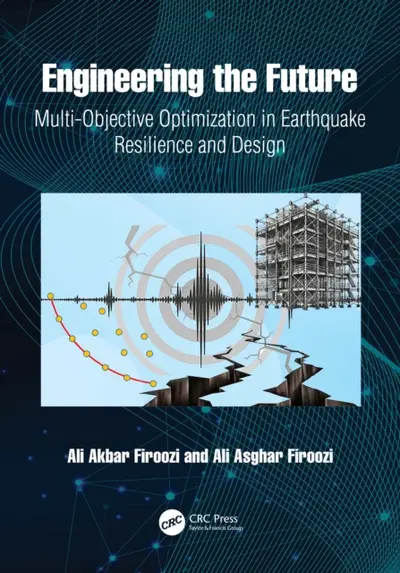
Engineering the Future
Multi-Objective Optimization in Earthquake Resilience and Design
Price and availability
$75.99
Available in: Andorra, Austria, Australia, Belgium, Bulgaria, Canada, Switzerland, Cyprus, Czechia, Germany, Denmark, Estonia, Spain, Finland, France, United Kingdom, Guernsey, Greece, Croatia, Hungary, Ireland, Isle of Man, Iceland, Italy, Jersey, Japan, Liechtenstein, Lithuania, Luxembourg, Latvia, Monaco, Malta, Netherlands, Norway, Poland, Portugal, Romania, Sweden, Slovenia, Slovakia, San Marino, United States, Vatican City, South Africa
Stores: US, UK, Canada, EU, Australia.
Sign in to buyThe price is re-checked by the server before payment.
For personal use under the eBook licence.
- Format
- EPUB
- DRM
- Not stated by the publisher
- Language
- English
- Publisher
- CRC Press
- Published
- 21 August 2026
- ISBN
- 9781040802380
- Subjects
- Geology & the lithosphere, Urban & municipal planning, Other manufacturing technologies, Materials science, Earthquake engineering, Interdisciplinary studies, Geology, geomorphology and the lithosphere, Urban and municipal planning and policy, Engineering: general, Other manufacturing technologies, Materials science, Civil engineering, surveying and building
About this book
Engineering the Future: Multi-Objective Optimization in Earthquake Resilience and Design develops a rigorous, decision-oriented treatment of performance-based earthquake engineering (PBEE) by placing multi-objective optimization (MOO) at the centre of modern seismic design and risk management. Moving beyond prescriptive "e;one-size-fits-all"e; compliance, the book frames seismic design as an explicit trade-off problem in which safety, functionality, downtime, repair cost, and sustainability targets must be satisfied simultaneously under uncertainty. It consolidates foundational concepts and current practice, and then advances toward implementation pathways that connect hazard characterization, structural response assessment, damage and loss modelling, and stakeholder-informed performance objectives within a coherent PBEE-MOO workflow.This book integrates technical methods with practice-facing considerations, including regulatory frameworks, governance and policy instruments, socio-economic consequences, and community resilience. It also surveys emerging computational capabilities, including advanced simulation and data-driven tools, and demonstrates their role in accelerating design-space exploration and improving transparency in decision-making. Case-based discussions across multiple structural systems illustrate how optimization can support defensible choices for new design, retrofit prioritization, and lifecycle resilience planning in earthquake-prone regions.This book targets structural and earthquake engineers, seismic risk analysts, and engineering researchers who seek to advance beyond traditional code-based design approaches by implementing sophisticated multi-objective optimization methods for performance-based earthquake engineering in both academic research and professional practice.
Bibliographic data © Gardners Books Ltd.