PDF · English
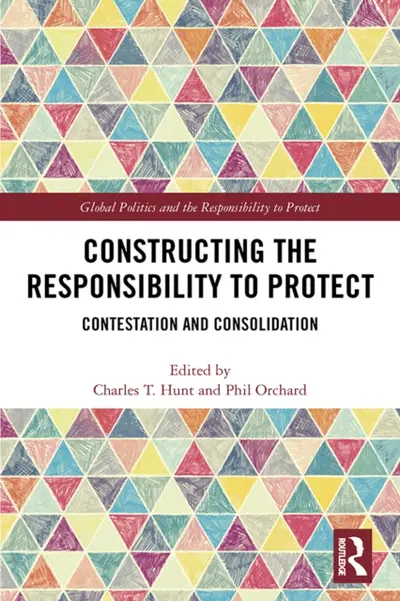
Constructing the Responsibility to Protect
Contestation and Consolidation
Price and availability
$63.99
Available in: Andorra, Austria, Australia, Belgium, Bulgaria, Canada, Switzerland, Cyprus, Czechia, Germany, Denmark, Estonia, Spain, Finland, France, United Kingdom, Guernsey, Greece, Croatia, Hungary, Ireland, Isle of Man, Iceland, Italy, Jersey, Japan, Liechtenstein, Lithuania, Luxembourg, Latvia, Monaco, Malta, Netherlands, Norway, Poland, Portugal, Romania, Sweden, Slovenia, Slovakia, San Marino, United States, Vatican City, South Africa
Stores: US, UK, Canada, EU, Australia.
Sign in to buyThe price is re-checked by the server before payment.
For personal use under the eBook licence.
- Format
- DRM
- Not stated by the publisher
- Language
- English
- Publisher
- Taylor & Francis
- Published
- 7 February 2020
- ISBN
- 9781000035681
- Subjects
- Peace studies & conflict resolution, Human rights, Peace studies and conflict resolution, International institutions / intergovernmental organizations, Warfare and defence, International law
About this book
This volume examines the ongoing construction of the Responsibility to Protect (R2P) doctrine, elaborating on areas of both consolidation and contestation.The book focuses on how the R2P doctrine has been both consolidated and contested along three dimensions, regarding its meaning, status and application. The first focuses on how the R2P should be understood in a theoretical sense, exploring it through the lens of the International Relations constructivist approach and through different toolkits available to conventional and critical constructivists. The second focuses on how the R2P interacts with other normative frameworks, and how this interaction can lead to a range of effects from mutual reinforcement and co-evolution through to unanticipated feedback that can undermine consensus and flexibility. The third focuses on how key state actors - including the United States, China and Russia - understand, use and contest the R2P. Together, the book's chapters demonstrate that broad aspects of the R2P are consolidated in the sense that they are accepted by states even while other, specific aspects, remain subject to contestation in practice and in policy.This book will be of much interest to students of the R2P, human rights, peace studies and international relations.
Bibliographic data © Gardners Books Ltd.