PDF · English
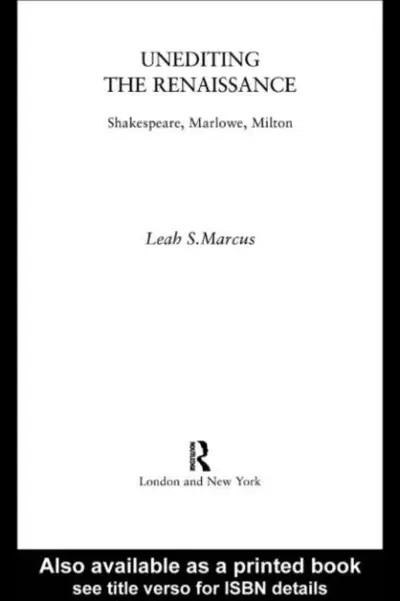
Unediting the Renaissance
Shakespeare, Marlowe and Milton
Price and availability
$59.99
Available in: Andorra, Austria, Australia, Belgium, Bulgaria, Canada, Switzerland, Cyprus, Czechia, Germany, Denmark, Estonia, Spain, Finland, France, United Kingdom, Guernsey, Greece, Croatia, Hungary, Ireland, Isle of Man, Iceland, Italy, Jersey, Japan, Liechtenstein, Lithuania, Luxembourg, Latvia, Monaco, Malta, Netherlands, Norway, Poland, Portugal, Romania, Sweden, Slovenia, Slovakia, San Marino, United States, Vatican City, South Africa
Stores: US, UK, Canada, EU, Australia.
Sign in to buyThe price is re-checked by the server before payment.
For personal use under the eBook licence.
- Format
- DRM
- Not stated by the publisher
- Language
- English
- Publisher
- Taylor & Francis
- Published
- 1 June 2002
- ISBN
- 9781134855933
- Subjects
- Literary studies: c 1500 to c 1800, Literary studies: poetry and poets, Literary studies: plays and playwrights, Interdisciplinary studies
About this book
Unediting the Renaissance is a path-breaking and timely look at the issues of the textual editing of Renaissance works. Both erudite and accessible, it will be a fascinating and provocative read for any Renaissance student or scholar. Leah Marcus argues that `bad' versions of Renaissance texts such as Shakespeare's First Folio should not be viewed as mutilated copies of originals, but rather reputable alternatives encoding differences in ideology, cultural meaning and other elements of performance. Marcus focuses on key Renaissance works- Dr Faustus, The Merry Wives of Windsor, The Taming of the Shrew, Hamlet and poems by Milton, Donne and Herrick - to re-exmaine how editorial intervention shapes the texts which are widely accepted as `definitive'. Examining the cultural attitudes, fears and influences which influence textual editors, from the seveteenth century to the present day, Marcus sheds new light on a previously unexamined aspect of Renaissance studies. A lively critique of current theoretical practices, Unediting the Renaissance will shift the ways in which Shakespeare and his contemporaries are edited and read.
Bibliographic data © Gardners Books Ltd.