PDF · English
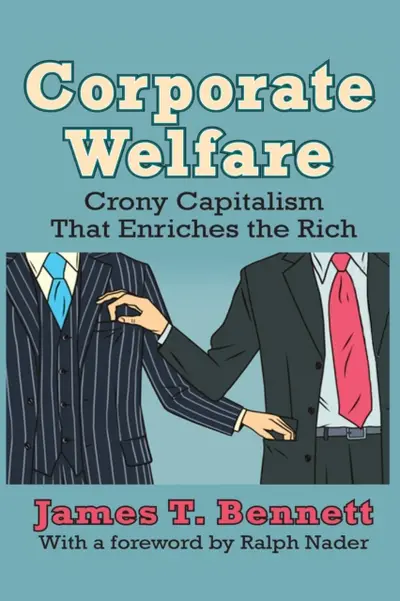
Corporate Welfare
Crony Capitalism That Enriches the Rich
Price and availability
$59.99
Available in: Andorra, Austria, Australia, Belgium, Bulgaria, Canada, Switzerland, Cyprus, Czechia, Germany, Denmark, Estonia, Spain, Finland, France, United Kingdom, Guernsey, Greece, Croatia, Hungary, Ireland, Isle of Man, Iceland, Italy, Jersey, Japan, Liechtenstein, Lithuania, Luxembourg, Latvia, Monaco, Malta, Netherlands, Norway, Poland, Portugal, Romania, Sweden, Slovenia, Slovakia, San Marino, United States, Vatican City, South Africa
Stores: US, UK, Canada, EU, Australia.
Sign in to buyThe price is re-checked by the server before payment.
For personal use under the eBook licence.
- Format
- DRM
- Not stated by the publisher
- Language
- English
- Publisher
- Taylor & Francis
- Published
- 5 July 2017
- ISBN
- 9781351525732
- Subjects
- USA, Sociology, Social welfare & social services, Economics, Economic systems & structures, United States of America, USA, Public administration / Public policy, Corruption in politics, government and society, Capitalism, Economic history
About this book
From the time of Alexander Hamilton's "e;Report on Manufactures"e; through the Great Depression, American towns and cities sought to lure footloose companies by offering lavish benefits. These ranged from taxpayer-financed factories, to tax exemptions, to outright gifts of money. This kind of government aid, known as "e;corporate welfare,"e; is still around today. After establishing its historical foundations, James T. Bennett reveals four modern manifestations.His first case is the epochal debate over government subsidy of a supersonic transport aircraft. The second case has its origins in Southern factory relocation programs of the 1930s the practice of state and local governments granting companies taxpayer financed incentives. The third is the taking of private property for the enrichment of business interests. The fourth export subsidies has its genesis in the New Deal but matured with the growth of the Export-Import Bank, which subsidizes international business exchanges of America's largest corporate entities.Bennett examines the prospects for a successful anti-corporate welfare coalition of libertarians, free market conservatives, Greens, and populists. The potential for a coalition is out there, he argues. Whether a canny politician can assemble and maintain it long enough to mount a taxpayer counterattack upon corporate welfare is an intriguing question.
Bibliographic data © Gardners Books Ltd.