EPUB · English
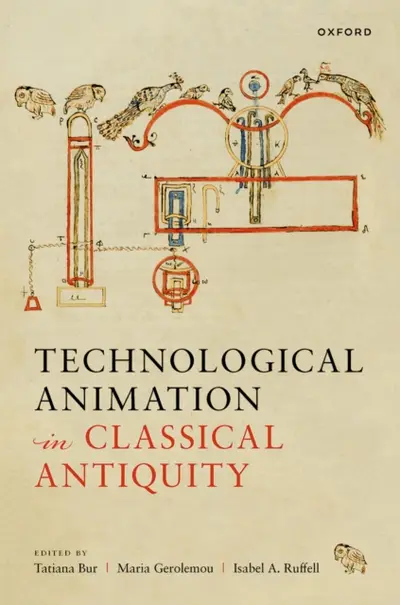
Technological Animation in Classical Antiquity
Price and availability
$118.99
Available in: Andorra, Austria, Australia, Belgium, Bulgaria, Canada, Switzerland, Cyprus, Czechia, Germany, Denmark, Estonia, Spain, Finland, France, United Kingdom, Guernsey, Greece, Croatia, Hungary, Ireland, Isle of Man, Iceland, Italy, Jersey, Japan, Liechtenstein, Lithuania, Luxembourg, Latvia, Monaco, Malta, Netherlands, Norway, Poland, Portugal, Romania, Sweden, Slovenia, Slovakia, San Marino, United States, Vatican City, South Africa
Stores: US, UK, Canada, EU, Australia.
Sign in to buyThe price is re-checked by the server before payment.
For personal use under the eBook licence.
- Format
- EPUB
- DRM
- Not stated by the publisher
- Language
- English
- Publisher
- Oxford University Press
- Published
- 24 September 2024
- ISBN
- 9780192672063
- Subjects
- History of art: ancient & classical art,BCE to c 500 CE, Ancient history: to c 500 CE, History of science, History of art, Ancient history, History of science
About this book
The persistent desire to animate inanimate objects has been a recurring theme in European culture dating back to ancient Greek and Roman times. Technological Animation in Classical Antiquity aims to establish, for the first time, the significance of this aspiration and its practical realization within Greek and Roman societies. While certain aspects of this narrative have been explored previously, this study shifts the focus to place technological animation at the forefront. The sixteen chapters examine the tangible existence of such devices across various media and considers their roles in diverse contexts, delving into the reciprocal relationship between technological and material realities, and its influence on the concept of animation and vice versa. By adopting this perspective, technological animation not only provides a new understanding of the processes behind animation but also lends a fresh perspective to the animated artifact. In contrast to other types of animation, where the technologically animated artifact is often dismissed as a perceptual error induced, for instance, by rhetoric or magic, this study separates technological animation from notions of rhetorical or magical skills, theurgy, or divine intervention. Specifically, it concentrates on a subset of artificial animation solely produced through technical procedures, exploring how various motive forces actively contributed to giving objects agency and impacting their viewers, illuminating how the material conditions of the artifacts themselves played a role in the process of technological animation--whether through the distinctive materiality of bronze or the design of a statuette's hinge.
Bibliographic data © Gardners Books Ltd.