EPUB · English
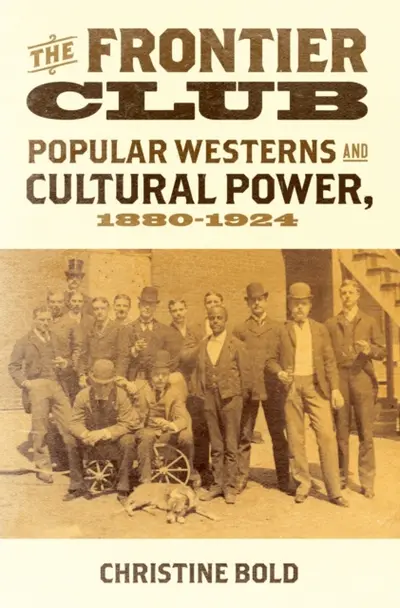
Frontier Club
Popular Westerns and Cultural Power, 1880-1924
Price and availability
$40.99
Available in: Andorra, Austria, Australia, Belgium, Bulgaria, Canada, Switzerland, Cyprus, Czechia, Germany, Denmark, Estonia, Spain, Finland, France, United Kingdom, Guernsey, Greece, Croatia, Hungary, Ireland, Isle of Man, Iceland, Italy, Jersey, Japan, Liechtenstein, Lithuania, Luxembourg, Latvia, Monaco, Malta, Netherlands, Norway, Poland, Portugal, Romania, Sweden, Slovenia, Slovakia, San Marino, United States, Vatican City, South Africa
Stores: US, UK, Canada, EU, Australia.
Sign in to buyThe price is re-checked by the server before payment.
For personal use under the eBook licence.
- Format
- EPUB
- DRM
- Not stated by the publisher
- Language
- English
- Publisher
- Oxford University Press
- Published
- 3 January 2013
- ISBN
- 9780199913022
- Subjects
- USA, Western & Pacific Coast states, c 1800 to c 1900, 20th century, Film: styles & genres, Literary studies: general, History of the Americas, Social & cultural history, United States of America, USA, 1KBB-US-W, 3MN, 3MP, ATFN, Literary studies: general, NHK, NHTB
About this book
From Hollywood films to novels by Louis L'Amour and television series like Gunsmoke and Deadwood, the Wild West has exerted a powerful hold on the cultural imagination of the United States. Beginning with Theodore Roosevelt's founding of the Boone and Crockett Club in 1887, Christine Bold traces the origins and evolution of the western genre, revealing how a group of prominent eastern aristocrats-a cadre she terms "e;the frontier club"e; -created and propagated the myth of the Wild West to advance their own self-interest as well as larger systems of privilege and exclusion. Mining institutional archives, personal papers, novels, and films, The Frontier Club excavates the hidden social, political, and financial interests behind the making of the modern western. It re-reads frontier-club fiction, most notably Owen Wister's bestseller The Virginian, in relation to federal policies and cultural spaces (from exclusive gentlemen's clubs to national parks to zoos); it casts new light on key clubmen, both the famous and the forgotten-figures such as Roosevelt, George Bird Grinnell, Silas Weir Mitchell, Henry Cabot Lodge, and Frederic Remington-while recovering the women on whom these men depended and without whom this version of the popular West would not exist; and it considers the costs of the frontier-club formula, in terms of its impact on Indigenous peoples and its marginalization of other popular voices, including western writings by African Americans, women, and working-class white men. An engaging cultural history that covers print culture, big-game hunting, politics, immigration, Jim Crow segregation, and environmental conservation at the turn of the twentieth century, The Frontier Club provides a welcome new perspective on the enduring American myth of the Wild West.
Bibliographic data © Gardners Books Ltd.