PDF · English
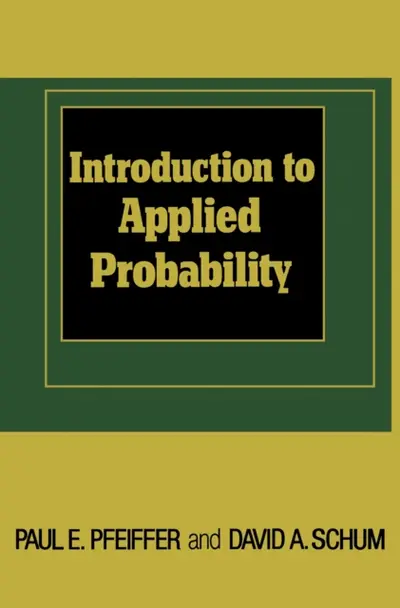
Introduction to Applied Probability
Price and availability
$59.99
Available in: Andorra, Austria, Australia, Belgium, Bulgaria, Canada, Switzerland, Cyprus, Czechia, Germany, Denmark, Estonia, Spain, Finland, France, United Kingdom, Guernsey, Greece, Croatia, Hungary, Ireland, Isle of Man, Iceland, Italy, Jersey, Japan, Liechtenstein, Lithuania, Luxembourg, Latvia, Monaco, Malta, Netherlands, Norway, Poland, Portugal, Romania, Sweden, Slovenia, Slovakia, San Marino, United States, Vatican City, South Africa
Stores: US, UK, Canada, EU, Australia.
Sign in to buyThe price is re-checked by the server before payment.
For personal use under the eBook licence.
- Format
- DRM
- Not stated by the publisher
- Language
- English
- Publisher
- Elsevier Science
- Published
- 10 May 2014
- ISBN
- 9781483277202
- Subjects
- Probability & statistics, Applied mathematics, Probability and statistics, Applied mathematics
About this book
Introduction to Applied Probability provides a basis for an intelligent application of probability ideas to a wide variety of phenomena for which it is suitable. It is intended as a tool for learning and seeks to point out and emphasize significant facts and interpretations which are frequently overlooked or confused by the beginner. The book covers more than enough material for a one semester course, enhancing the value of the book as a reference for the student. Notable features of the book are: the systematic handling of combinations of events (Section 3-5); extensive use of the mass concept as an aid to visualization; an unusually careful treatment of conditional probability, independence, and conditional independence (Section 6-4); the resulting clarification facilitates the formulation of many applied problems; the emphasis on events determined by random variables, which gives unity and clarity to many topics important for interpretation; and the utilization of the indicator function, both as a tool for dealing with events and as a notational device in the handling of random variables. Students of mathematics, engineering, biological and physical sciences will find the text highly useful.
Bibliographic data © Gardners Books Ltd.