PDF · English
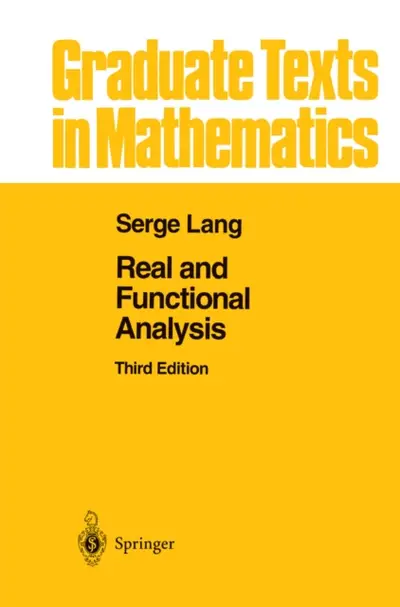
Real and Functional Analysis
Price and availability
$67.99
Available in: Andorra, Austria, Australia, Belgium, Bulgaria, Canada, Switzerland, Cyprus, Czechia, Germany, Denmark, Estonia, Spain, Finland, France, United Kingdom, Guernsey, Greece, Croatia, Hungary, Ireland, Isle of Man, Iceland, Italy, Jersey, Japan, Liechtenstein, Lithuania, Luxembourg, Latvia, Monaco, Malta, Netherlands, Norway, Poland, Portugal, Romania, Sweden, Slovenia, Slovakia, San Marino, United States, Vatican City, South Africa
Stores: US, UK, Canada, EU, Australia.
Sign in to buyThe price is re-checked by the server before payment.
For personal use under the eBook licence.
- Format
- DRM
- Not stated by the publisher
- Language
- English
- Publisher
- Springer New York
- Published
- 6 December 2012
- ISBN
- 9781461208976
- Subjects
- Calculus & mathematical analysis, Real analysis, real variables, Calculus and mathematical analysis, Real analysis, real variables
About this book
This book is meant as a text for a first year graduate course in analysis. Any standard course in undergraduate analysis will constitute sufficient preparation for its understanding, for instance, my Undergraduate Anal- ysis. I assume that the reader is acquainted with notions of uniform con- vergence and the like. In this third edition, I have reorganized the book by covering inte- gration before functional analysis. Such a rearrangement fits the way courses are taught in all the places I know of. I have added a number of examples and exercises, as well as some material about integration on the real line (e.g. on Dirac sequence approximation and on Fourier analysis), and some material on functional analysis (e.g. the theory of the Gelfand transform in Chapter XVI). These upgrade previous exercises to sections in the text. In a sense, the subject matter covers the same topics as elementary calculus, viz. linear algebra, differentiation and integration. This time, however, these subjects are treated in a manner suitable for the training of professionals, i.e. people who will use the tools in further investiga- tions, be it in mathematics, or physics, or what have you. In the first part, we begin with point set topology, essential for all analysis, and we cover the most important results.
Bibliographic data © Gardners Books Ltd.