PDF · English
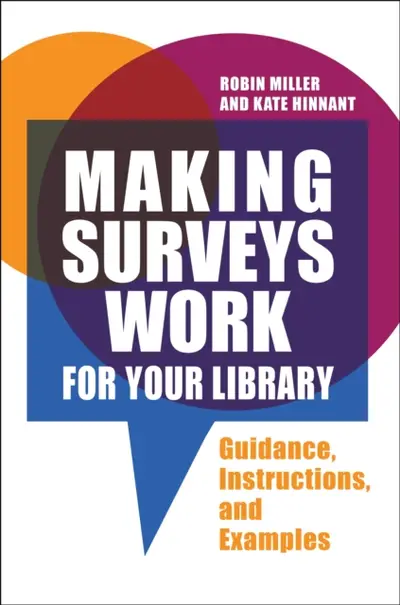
Making Surveys Work for Your Library
Guidance, Instructions, and Examples
Price and availability
$48.99
Available in: Andorra, Austria, Australia, Belgium, Bulgaria, Canada, Switzerland, Cyprus, Czechia, Germany, Denmark, Estonia, Spain, Finland, France, United Kingdom, Guernsey, Greece, Croatia, Hungary, Ireland, Isle of Man, Iceland, Italy, Jersey, Japan, Liechtenstein, Lithuania, Luxembourg, Latvia, Monaco, Malta, Netherlands, Norway, Poland, Portugal, Romania, Sweden, Slovenia, Slovakia, San Marino, United States, Vatican City, South Africa
Stores: US, UK, Canada, EU, Australia.
Sign in to buyThe price is re-checked by the server before payment.
For personal use under the eBook licence.
- Format
- DRM
- Not stated by the publisher
- Language
- English
- Publisher
- Bloomsbury Publishing (USA)
- Published
- 1 December 2018
- Pages
- 128
- ISBN
- 9781440861086
- Subjects
- Library & information sciences, Library, archive & information management, Library and information sciences / Museology, Library, archive and information management
About this book
Instead of using expensive off-the-shelf surveys or relying on a poorly worded survey, read Making Surveys Work for Your Library and design your own that collect actionable data.Library listservs and websites are littered with examples of surveys that are too long, freighted with complex language, and generally poorly designed. The survey, however, is a widely used tool that has great potential if designed well. Libraries can implement surveys for a variety of purposes, including planning, program evaluation, collection development, and space design.Making Surveys Work for Your Library: Guidance, Instructions, and Examples offers librarians a contemporary and practical approach to creating surveys that answer authentic questions about library users. Miller and Hinnant have experience designing, deploying, and analyzing quantitative and qualitative data from large-scale, web-based user surveys of library patrons as well as smaller survey instruments targeted to special populations. Here, they offer library professionals a guide to developing-and examples of-concise surveys that gather the data they need to make evidence-based decisions, define the scope of future research, and understand their patrons.
Bibliographic data © Gardners Books Ltd.