PDF · English
1837
Russia''s Quiet Revolution
Price and availability
$16.99
Available in: Andorra, Austria, Australia, Belgium, Bulgaria, Canada, Switzerland, Cyprus, Czechia, Germany, Denmark, Estonia, Spain, Finland, France, United Kingdom, Guernsey, Greece, Croatia, Hungary, Ireland, Isle of Man, Iceland, Italy, Jersey, Japan, Liechtenstein, Lithuania, Luxembourg, Latvia, Monaco, Malta, Netherlands, Norway, Poland, Portugal, Romania, Sweden, Slovenia, Slovakia, San Marino, United States, Vatican City, South Africa
Stores: US, UK, Canada, EU, Australia.
Sign in to buyThe price is re-checked by the server before payment.
For personal use under the eBook licence.
- Format
- DRM
- Not stated by the publisher
- Language
- English
- Publisher
- Oxford University Press
- Published
- 12 February 2021
- ISBN
- 9780192560872
- Subjects
- Russia, c 1800 to c 1900, European history, Modern history to 20th century: c 1700 to c 1900, Colonialism & imperialism, European history, Colonialism and imperialism
About this book
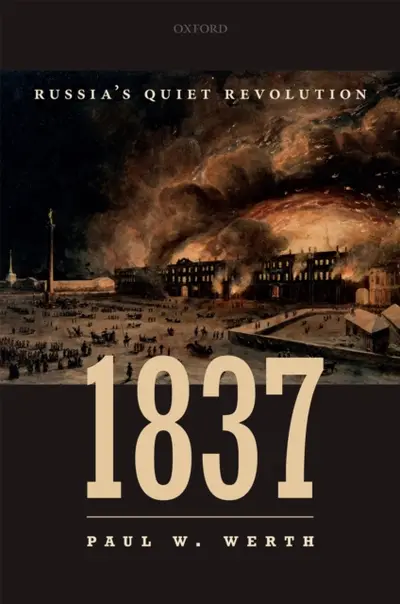
Historians often think of Russia before the 1860s in terms of conservative stasis, when the "e;gendarme of Europe"e; secured order beyond the country's borders and entrenched the autocratic system at home. This book offers a profoundly different vision of Russia under Nicholas I. Drawing on an extensive array of sources, it reveals that many of modern Russia's most distinctive and outstanding features can be traced back to an inconspicuous but exceptional year. Russia became what it did, in no small measure, because of 1837. The catalogue of the year's noteworthy occurrences extends from the realms of culture, religion, and ideas to those of empire, politics, and industry. Exploring these diverse issues and connecting seemingly divergent historical actors, Paul W. Werth reveals that the 1830s in Russia were a period of striking dynamism and consequence, and that 1837 was pivotal for the country's entry into the modern age. From the romantic death of Russia's greatest poet Alexander Pushkin in January to a colossal fire at the Winter Palace in December, Russia experienced much that was astonishing in 1837: the railway and provincial press appeared, Russian opera made its debut, Orthodoxy pushed westward, the first Romanov visited Siberia and much else besides. The cumulative effect was profound. The country's integration accelerated, and a Russian nation began to emerge, embodied in new institutions and practices, within the larger empire. The result was a quiet revolution, after which Russia would never be the same.
Bibliographic data © Gardners Books Ltd.