PDF · English
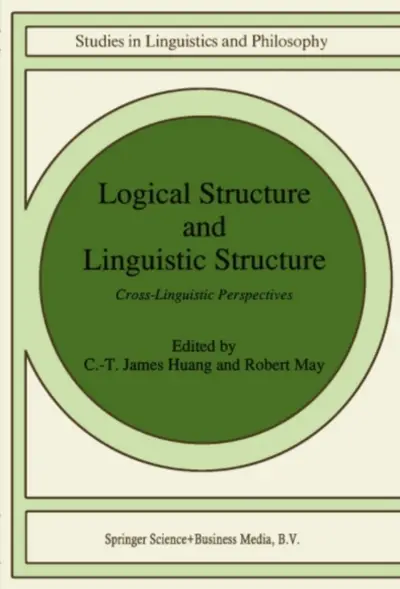
Logical Structure and Linguistic Structure
Cross-Linguistic Perspectives
Price and availability
$60.99
Available in: Andorra, Austria, Australia, Belgium, Bulgaria, Canada, Switzerland, Cyprus, Czechia, Germany, Denmark, Estonia, Spain, Finland, France, United Kingdom, Guernsey, Greece, Croatia, Hungary, Ireland, Isle of Man, Iceland, Italy, Jersey, Japan, Liechtenstein, Lithuania, Luxembourg, Latvia, Monaco, Malta, Netherlands, Norway, Poland, Portugal, Romania, Sweden, Slovenia, Slovakia, San Marino, United States, Vatican City, South Africa
Stores: US, UK, Canada, EU, Australia.
Sign in to buyThe price is re-checked by the server before payment.
For personal use under the eBook licence.
- Format
- DRM
- Not stated by the publisher
- Language
- English
- Publisher
- Springer Netherlands
- Published
- 6 December 2012
- ISBN
- 9789401134729
- Subjects
- Philosophy of language, Semantics, discourse analysis, etc, Grammar, syntax and morphology, Semiotics / semiology
About this book
In comparative syntax a general approach has been pursued over the past decade predicated on the notion that Universal Grammar allows of open parameters, and that part of the job of linguistic theory is to specify what values these parameters may have, and how they may be set, given primary linguistic data, to determine the grammars of particu- lar languages. The papers presented in this volume are also concerned with language variation understood in this way. Their goals, however, do not strictly fall under the rubric of comparative syntax, but form part of what is more properly thought of as a comparative semantics. Semantics, in its broadest sense, is concerned with how linguistic structures are associated with their truth-conditions. A comparative semantics, therefore, is concerned with whether this association can vary from language to language, and if so, what is the cause of this variation. Taking comparative semantics in this way places certain inherent limitations on the search for the sources of variability. This is because the semantic notion of truth is universal, and does not vary from language to language: Sentences either do or do not accurately characterize what they purport to describe. ! The source of semantic variability, therefore, must be somehow located in the way a language is structured.
Bibliographic data © Gardners Books Ltd.